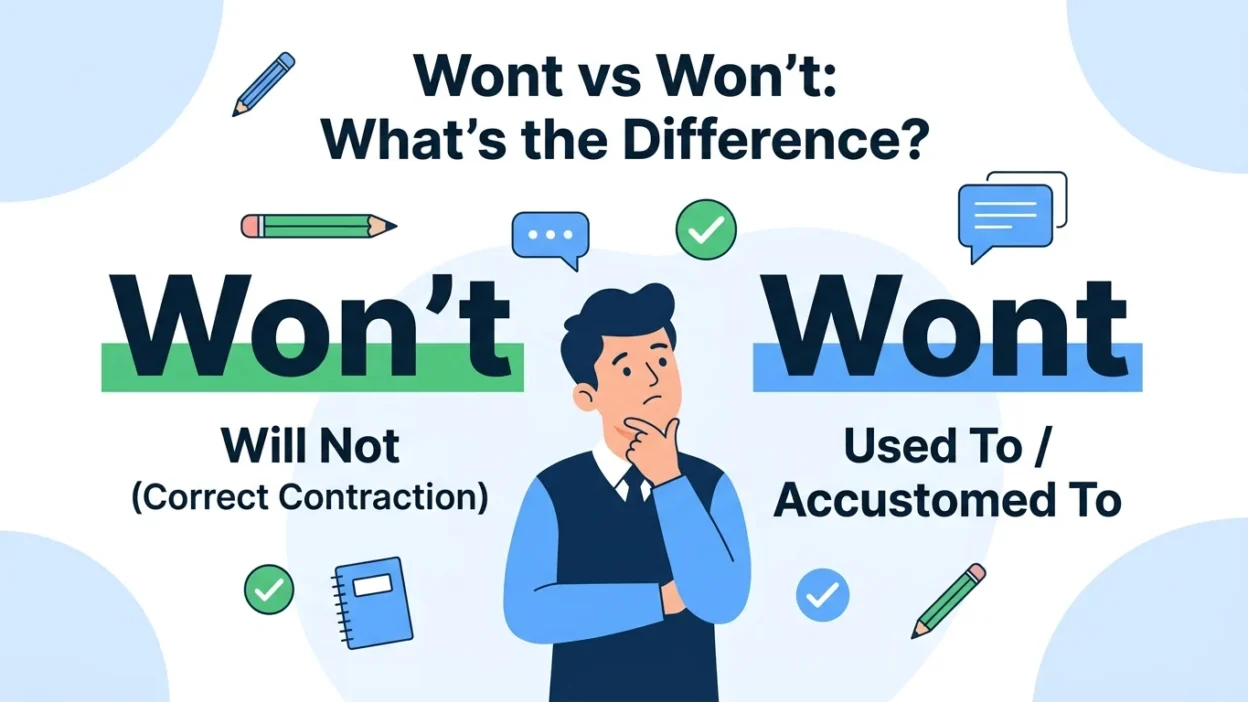
Many English learners get confused by wont and won’t because they look almost the same. The only visible difference is the apostrophe (’), but that small mark changes the meaning completely.
In everyday English, people often see won’t in conversations, emails, social media posts, and books. On the other hand, wont appears much less often, so many readers are not sure whether it is a spelling mistake or a real word.
The good news is that understanding the difference is simple once you know what each word means and how it is used.
Quick Answer
- Won’t = short form of will not
- Wont = a real English word meaning accustomed to or used to
- Won’t is extremely common in modern English
- Wont is rare in everyday conversation
- Most of the time, people actually mean won’t
Examples
- I won’t go to the party. ✅
- She won’t answer the phone. ✅
- He was wont to arrive early. ✅
- I wont go to the party. ❌
Simple Origin or Background Explanation
Understanding where these words come from can make them easier to remember.
The Word “Won’t”
Won’t is the shortened form of will not.
Examples:
- I will not come.
- I won’t come.
English has many shortened forms called contractions:
- Do not → don’t
- Cannot → can’t
- Is not → isn’t
- Will not → won’t
You may notice that won’t does not look exactly like will not. That is because its spelling developed over many years of English language history.
The Word “Wont”
Wont is an older English word. It means someone is accustomed to doing something or usually behaves in a certain way.
Example:
- She was wont to read before bedtime.
Today, this word is mostly found in formal writing, older books, or historical texts.
Clear Explanation of the Difference
The main difference is that these words have completely different meanings.
What Does “Won’t” Mean?
Won’t means will not.
It talks about something that is not going to happen in the future.
Examples:
- I won’t forget your birthday.
- They won’t be late.
- We won’t travel next week.
In these examples, won’t expresses a future negative action.
What Does “Wont” Mean?
Wont means accustomed to, used to, or having a habit of doing something.
Examples:
- He was wont to take a walk every evening.
- She was wont to help her neighbors.
- They were wont to meet on Fridays.
This usage is uncommon in everyday speech.
The Easy Memory Trick
Ask yourself:
Can I replace the word with “will not”?
If yes, use won’t.
Example:
- She won’t attend the meeting.
- She will not attend the meeting.
The sentence still works, so won’t is correct.
If the meaning is “used to” or “accustomed to,” use wont.
Example:
- He was wont to wake up before sunrise.
This means he usually woke up before sunrise.
Comparison
| Feature | Won’t | Wont |
| Part of speech | Contraction | Adjective |
| Meaning | Will not | Accustomed to, used to |
| Common today? | Very common | Rare |
| Has apostrophe? | Yes | No |
| Used in daily conversation? | Yes | Rarely |
| Talks about future? | Yes | No |
| Example | I won’t go. | He was wont to travel. |
Which One to Use and When
Use “Won’t” When Talking About the Future
Use won’t whenever you mean will not.
Examples:
- I won’t be there tomorrow.
- She won’t agree with that idea.
- We won’t forget the event.
Use “Wont” When Meaning “Accustomed To”
Use wont when describing a habit or usual behavior.
Examples:
- He was wont to exercise daily.
- She was wont to write letters.
- They were wont to gather every weekend.
What Most Learners Need
For most students and everyday writers:
- You will use won’t very often.
- You may rarely need wont.
Common Mistakes People Make
Mistake 1: Forgetting the Apostrophe
Incorrect:
- I wont come tomorrow.
Correct:
- I won’t come tomorrow.
The apostrophe is important because it shows the contraction of will not.
Mistake 2: Thinking “Wont” Is Always Wrong
Some people believe wont is simply a misspelling.
Example:
- He was wont to arrive early.
This sentence is correct because wont is being used with its real meaning.
Mistake 3: Using “Wont” Instead of “Won’t”
Incorrect:
- She wont answer my message.
Correct:
- She won’t answer my message.
The sentence means will not answer, so won’t is needed.
Mistake 4: Using “Won’t” for Habits
Incorrect:
- He was won’t to read every night.
Correct:
- He was wont to read every night.
The sentence describes a habit, not a future action.
Everyday Real Life Examples
Emails
- I won’t be available this afternoon.
- We won’t attend the meeting tomorrow.
- The report won’t be ready today.
News
- The company won’t increase prices this year.
- Officials say the storm won’t reach the city.
- The project won’t start until next month.
Social Media
- I won’t spoil the movie ending.
- We won’t give up.
- They won’t believe what happened today.
Daily Conversations
- I won’t eat spicy food.
- She won’t come with us.
- They won’t stay long.
Rare Formal Examples Using “Wont”
- The professor was wont to begin class exactly on time.
- He was wont to spend evenings reading.
- The family was wont to gather for dinner every Sunday.
Short Learning Section for Students and Beginners
Here is a simple study guide.
Remember This Rule
Won’t = Will not
Examples:
- I won’t quit.
- She won’t forget.
- They won’t leave early.
Remember This Rule Too
Wont = Used to or accustomed to
Examples:
- He was wont to arrive early.
- She was wont to help others.
Quick Practice
Choose the correct word.
- I _____ call you later.
- Answer: won’t
- She was _____ to read every morning.
- Answer: wont
- They _____ agree with the plan.
- Answer: won’t
- He was _____ to take long walks.
- Answer: wont
Easy Tip
If you can replace the word with will not, choose won’t.
FAQ
Is “wont” a real word?
Yes. Wont is a real English word that means accustomed to or used to doing something.
Is “won’t” short for “will not”?
Yes. Won’t is the contraction of will not.
Which word is more common?
Won’t is much more common in modern English.
Can I use “wont” in everyday conversation?
You can, but it is rare. Most people use simpler phrases like “used to” instead.
Why does “won’t” have an apostrophe?
The apostrophe shows that letters have been removed from will not to create the contraction won’t.
Is “I wont go” correct?
No. The correct sentence is:
- I won’t go.
What can replace “wont”?
You can often replace it with:
- used to
- accustomed to
- habitually
How can I quickly remember the difference?
Remember:
- Won’t = will not
- Wont = used to
The apostrophe is usually the clue.
Conclusion
The difference between wont and won’t is simple once you know their meanings. Won’t is the contraction of will not and is used every day when talking about future actions that will not happen. Wont, without an apostrophe, is a much older and less common word that means someone is accustomed to doing something.
For most writing, emails, conversations, and social media posts, you will probably use won’t. When reading older or more formal English, you may occasionally see wont used to describe a person’s usual habits.
A good rule to remember is this: if you can replace the word with will not, choose won’t. If the meaning is used to or accustomed to, choose wont. This simple test will help you choose the correct word every time.