Many English learners mix up bear and bare because they sound exactly the same when spoken. Words like this are called homophones, words that sound alike but have different meanings and spellings.
At first, the two words may seem very similar. But their meanings are actually very different.
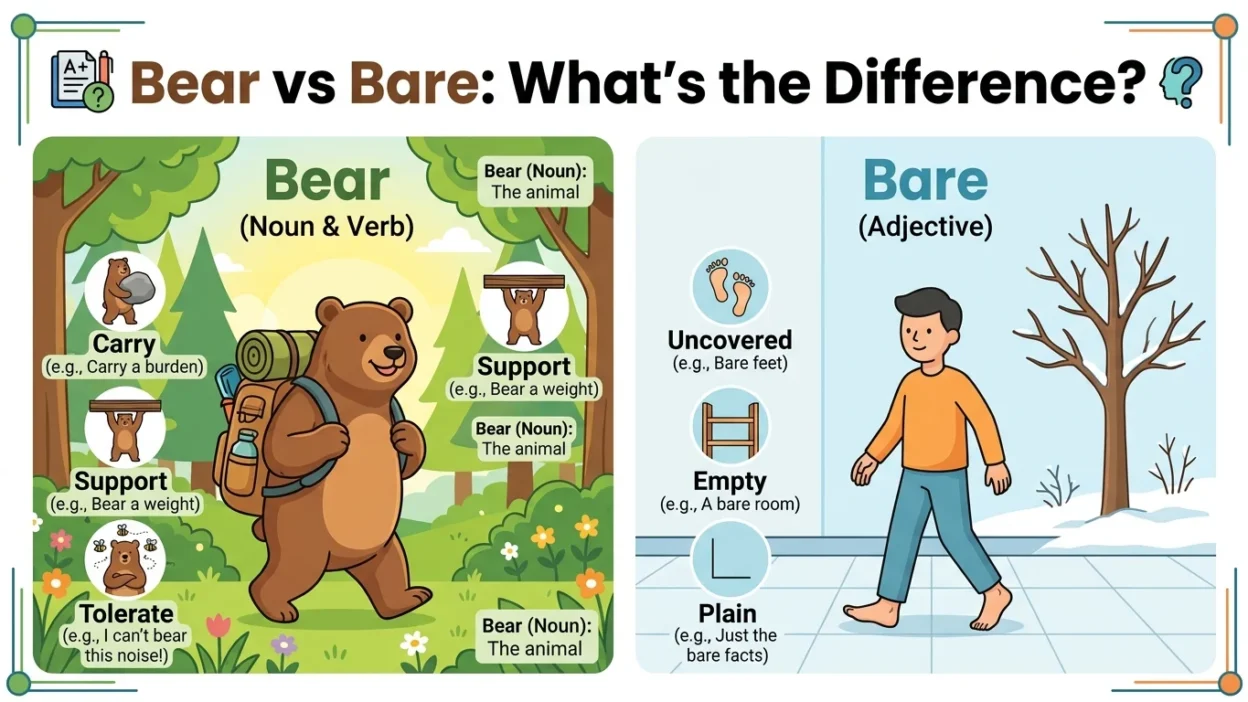
- Bear is often connected with carrying, accepting, or an animal.
- Bare is connected with being uncovered, empty, or plain.
Understanding the difference becomes much easier when you see simple explanations and real examples from daily life.
Quick Answer
Here is the easiest way to remember the difference:
Use bear when talking about:
- Carrying something
- Accepting pain or trouble
- Supporting something
- The large animal called a bear
Use bare when talking about:
- Something uncovered
- Empty or plain
- Without clothing or protection
Simple examples:
- I cannot bear the noise.
- He walked on the bare floor.
- The tree was bare in winter.
- She had to bear the responsibility.
Simple Origin or Background Explanation
The word bear comes from very old English words connected with:
- carrying,
- bringing,
- supporting,
- and enduring difficult things.
Over time, it also became the name of the large furry animal.
The word bare developed from old words meaning:
- uncovered,
- open,
- or empty.
Even though they sound the same today, they grew from different meanings long ago.
Clear Explanation of the Difference
The main difference is very simple:
“Bear” = carry, handle, accept, or the animal
“Bear” is usually used as a verb. It often means:
- to carry something,
- to deal with something difficult,
- or to accept pain, pressure, or trouble.
It can also be used as a noun for the animal.
Examples:
- She could not bear the sadness.
- The bridge can bear heavy trucks.
- We saw a bear in the forest.
“Bare” = uncovered or empty
“Bare” is usually an adjective. It describes something with nothing covering it.
Examples:
- He walked with bare feet.
- The walls were completely bare.
- The trees looked bare in winter.
Comparison
| Word | Meaning | Part of Speech | Easy Idea to Remember | Example |
| Bear | Carry, accept, support, or the animal | Verb/Noun | Handling something | I cannot bear the heat. |
| Bare | Uncovered, empty, plain | Adjective/Verb | Nothing covering it | She stood on the bare ground. |
Which One to Use and When
Use “bear” when talking about carrying or handling something
This can be physical or emotional.
Physical meaning:
- The chair can bear your weight.
- The truck cannot bear such a heavy load.
Emotional meaning:
- I cannot bear the pain.
- He could not bear the bad news.
Animal meaning:
- A brown bear crossed the road.
Use “bare” when talking about something uncovered
Body parts:
- She walked with bare feet.
- His bare hands were cold.
Empty places:
- The room looked bare.
- The shelves were almost bare.
Nature:
- The trees became bare after autumn.
Common Mistakes People Make
Mistake 1: Using “bare” instead of “bear”
❌ I cannot bare this noise.
✅ I cannot bear this noise.
Why?
Because the sentence talks about handling or tolerating something difficult.
Mistake 2: Using “bear” for uncovered things
❌ He walked on the bear floor.
✅ He walked on the bare floor.
Why?
Because the floor is uncovered.
Mistake 3: Forgetting that “bear” is also an animal
Some learners only remember the verb meaning.
Example:
- The children saw a huge bear at the zoo.
Mistake 4: Confusing spelling because of pronunciation
Since both words sound the same, many people write the wrong spelling in emails, messages, or school work.
A quick memory trick helps:
- Bare has “a” like “air” and “open air.”
- Bear has “ear” like listening to problems you must handle.
Everyday Real Life Examples
Emails
- I cannot bear another delay in the project.
- Please come with bare minimum luggage.
News
- A wild bear entered the village last night.
- Farmers reported bare fields after the storm.
Social Media
- “I can’t bear this heat anymore!”
- “Winter trees look so bare and beautiful.”
Daily Conversations
- She could not bear the loud music.
- He walked across the bare ground.
- The walls are still bare after moving in.
- That bear looks huge.
Short Learning Section for Students and Beginners
Learning confusing English words becomes easier when you connect them with simple pictures in your mind.
Picture idea for “bear”
Imagine:
- carrying a heavy bag,
- dealing with stress,
- or a large animal.
All these ideas connect with strength and support.
Picture idea for “bare”
Imagine:
- empty walls,
- uncovered feet,
- or trees without leaves.
These ideas connect with openness and nothing covering something.
Easy Memory Trick
BEAR = carry or handle
Think:
- “I can’t bear the pressure.”
BARE = uncovered
Think:
- “My feet are bare.”
Practice Sentences
Choose the correct word:
- The trees were _____ after winter.
- I cannot _____ this smell.
- The bridge can _____ heavy traffic.
- She walked with _____ feet.
Answers:
- bare
- bear
- bear
- bare
FAQ
Is “bear” a verb or a noun?
It can be both.
Verb:
- I cannot bear the pain.
Noun:
- The bear was sleeping.
Is “bare” always an adjective?
Mostly yes, but sometimes it can be a verb meaning “to uncover.”
Example:
- He bared his teeth.
Why do “bear” and “bare” sound the same?
English has many homophones words with different spellings and meanings but the same pronunciation.
Which word means “uncovered”?
“Bare” means uncovered.
Example:
- bare walls
- bare feet
Which word means “tolerate” or “handle”?
“Bear” means tolerate or handle.
Example:
- I cannot bear the pain.
Can “bear” mean carrying weight?
Yes.
Example:
- This shelf can bear heavy books.
What does “bare minimum” mean?
It means the smallest or least amount needed.
Example:
- Bring the bare minimum for the trip.
How can I remember the difference easily?
Remember:
- Bear = handle or carry
- Bare = uncovered or empty
Conclusion
The difference between bear and bare becomes simple once you connect each word with its main idea.
- Bear usually means to carry, support, handle, or tolerate something. It can also mean the animal.
- Bare means uncovered, empty, or plain.
Even though both words sound the same, their meanings are completely different.
The best way to remember them is through practice and real life examples. After reading and using these words a few times, choosing the correct one will start to feel natural and easy.