
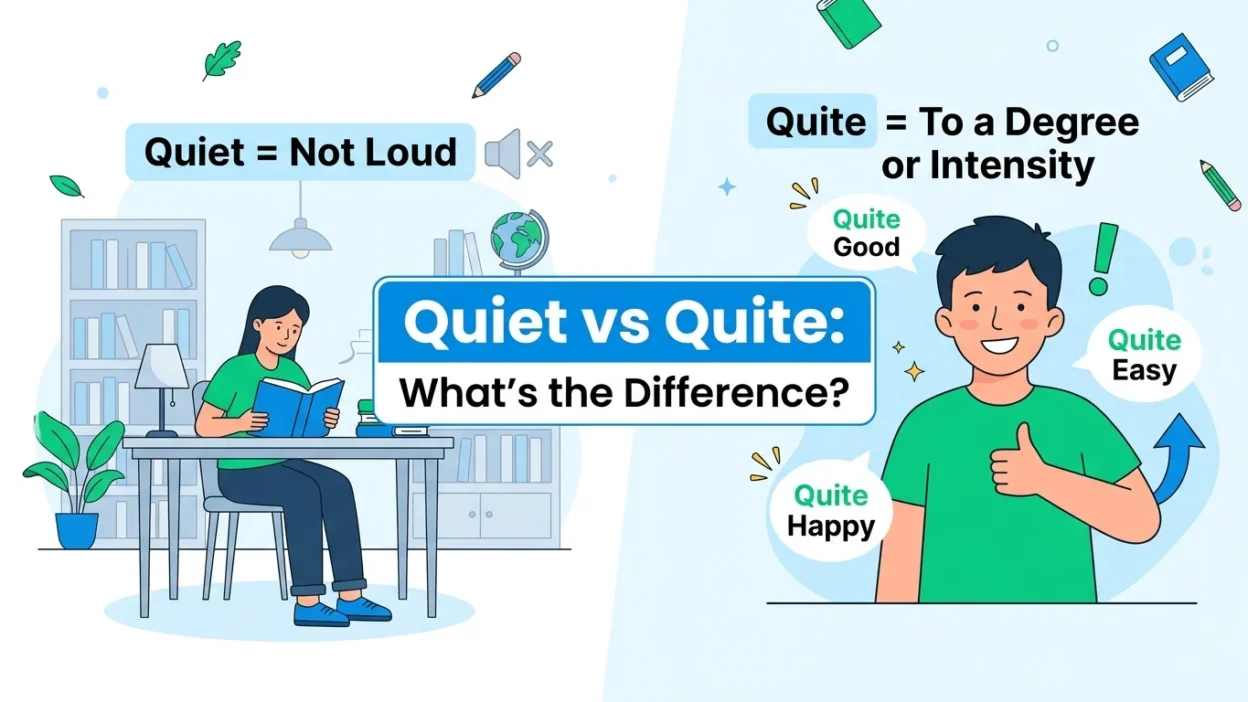
Many English learners mix up quiet and quite because the two words look very similar. They have almost the same letters, and when spoken quickly, they can sound alike too.
However, their meanings are completely different.
Using the wrong one can change the meaning of a sentence and sometimes make your writing confusing. The good news is that once you understand the difference, it becomes much easier to use both words correctly.
This guide explains everything in simple English so you can remember the difference forever.
Quick Answer
Here is the easiest way to remember:
- Quiet = not loud, making little or no noise
- Quite = fairly, very, or completely
Examples
- The library is quiet. ✔️
- I am quite happy today. ✔️
Think of it this way:
- Quiet talks about sound.
- Quite talks about degree or amount.
Simple Origin or Background Explanation
Although quiet and quite look similar, they developed with different meanings.
Quiet
The word quiet has been used for a long time to describe:
- Silence
- Calmness
- Lack of noise
Examples:
- A quiet room
- A quiet street
- A quiet voice
Quite
The word quite developed as a word that adds strength to another word.
Examples:
- Quite good
- Quite difficult
- Quite interesting
It helps describe how much or to what degree something is true.
Clear Explanation of the Difference
The biggest difference is what each word describes.
Quiet Describes Noise
Use quiet when talking about sound or the absence of sound.
Examples:
- Please be quiet.
- The baby is finally quiet.
- We enjoyed a quiet evening at home.
In all these examples, the word relates to noise or silence.
Quite Describes Degree
Use quite when you want to say:
- Fairly
- Very
- Completely
Examples:
- The movie was quite good.
- She is quite busy today.
- That answer is quite correct.
In these examples, quite adds meaning to another word.
Comparison Table
| Feature | Quiet | Quite |
| Meaning | Not loud | Fairly, very, completely |
| Part of Speech | Adjective | Adverb |
| Talks About | Sound or silence | Degree or amount |
| Example | The room is quiet. | The room is quite clean. |
| Related Idea | Calmness | Strengthening a description |
| Question It Answers | How noisy is it? | How much? |
Which One to Use and When
Use “Quiet” When Talking About Noise
Choose quiet if you mean:
- Silent
- Peaceful
- Not loud
Examples:
- The classroom became quiet.
- We stayed in a quiet hotel.
- He spoke in a quiet voice.
Use “Quite” When Adding Strength to an Idea
Choose quite if you mean:
- Fairly
- Very
- Completely
Examples:
- The test was quite easy.
- She is quite talented.
- The weather is quite warm today.
Quick Memory Trick
Remove the word and see what happens.
Example:
- She is quite smart.
Without “quite”:
- She is smart.
The sentence still works. The word simply adds strength.
Now look at this:
- The room is quiet.
Without “quiet”:
- The room is.
The sentence no longer makes sense because quiet is the main description.
Common Mistakes People Make
Mistake 1: Using “Quite” Instead of “Quiet”
❌ Please be quite.
✔️ Please be quiet.
Why?
You are asking someone not to make noise.
Mistake 2: Using “Quiet” Instead of “Quite”
❌ The movie was quiet interesting.
✔️ The movie was quite interesting.
Why?
You are describing the degree of interest, not the sound.
Mistake 3: Mixing Them Up in Writing
❌ I am looking for a quite place to study.
✔️ I am looking for a quiet place to study.
A study place should be silent, so use quiet.
Mistake 4: Forgetting the Meaning
Many learners see similar spelling and assume the words are interchangeable.
They are not.
Remember:
- Quiet = silence
- Quite = degree
Everyday Real Life Examples
Emails
Quiet
- I need a quiet place to join the meeting.
- The office was quiet this morning.
Quite
- The presentation was quite helpful.
- Your report is quite clear.
News
Quiet
- The town remained quiet during the night.
- Residents enjoyed a quiet weekend.
Quite
- The event was quite successful.
- Experts are quite confident about the results.
Social Media
Quiet
- I need a quiet day away from my phone.
- This coffee shop is surprisingly quiet.
Quite
- That video is quite funny.
- The new update is quite useful.
Daily Conversations
Quiet
- Can you be quiet for a minute?
- The children are unusually quiet today.
Quite
- I’m quite tired after work.
- Dinner was quite delicious.
Short Learning Section for Students and Beginners
Here are some simple exercises.
Choose the Correct Word
- The classroom is very ______.
- I am ______ happy today.
- Please stay ______ during the movie.
- The homework was ______ easy.
- We found a ______ place to relax.
Answers
- quiet
- quite
- quiet
- quite
- quiet
Easy Memory Rule
Think about the word noise.
If the sentence is about noise or silence, choose quiet.
If the sentence is about how much, how strong, or how true something is, choose quite.
FAQ
Is quiet the same as quite?
No.
Quiet means not loud.
Quite means fairly, very, or completely.
Which word means silent?
Quiet means silent or nearly silent.
Example:
- The room was quiet.
Which word means very?
Quite can mean very in many situations.
Example:
- She is quite happy.
Can quiet be used as a noun?
Usually, people use quiet as an adjective, but it can also refer to a state of calmness or silence.
Example:
- We enjoyed the quiet of the countryside.
Is quite always the same as very?
Not always.
Sometimes quite means “fairly,” and sometimes it means “completely.” The exact meaning depends on the sentence.
Why do learners confuse these words?
Because:
- They look similar.
- They have almost the same letters.
- Their pronunciation is somewhat similar.
How can I remember the difference easily?
Use this simple rule:
- Quiet = silence
- Quite = degree
Can I use quiet and quite in the same sentence?
Yes.
Example:
- The library was quiet, and it was quite comfortable for studying.
Conclusion
The difference between quiet and quite is actually simple once you know what each word means.
- Quiet means not loud, calm, or silent.
- Quite means fairly, very, or completely.
Whenever you see these words, ask yourself one question:
Am I talking about noise or about degree?
If it is about noise or silence, use quiet.
If it is about how much or how strongly something is true, use quite.
Remember this simple phrase:
“Quiet is silence. Quite is strength.”
With that rule in mind, you will be able to use both words correctly in speaking and writing.