
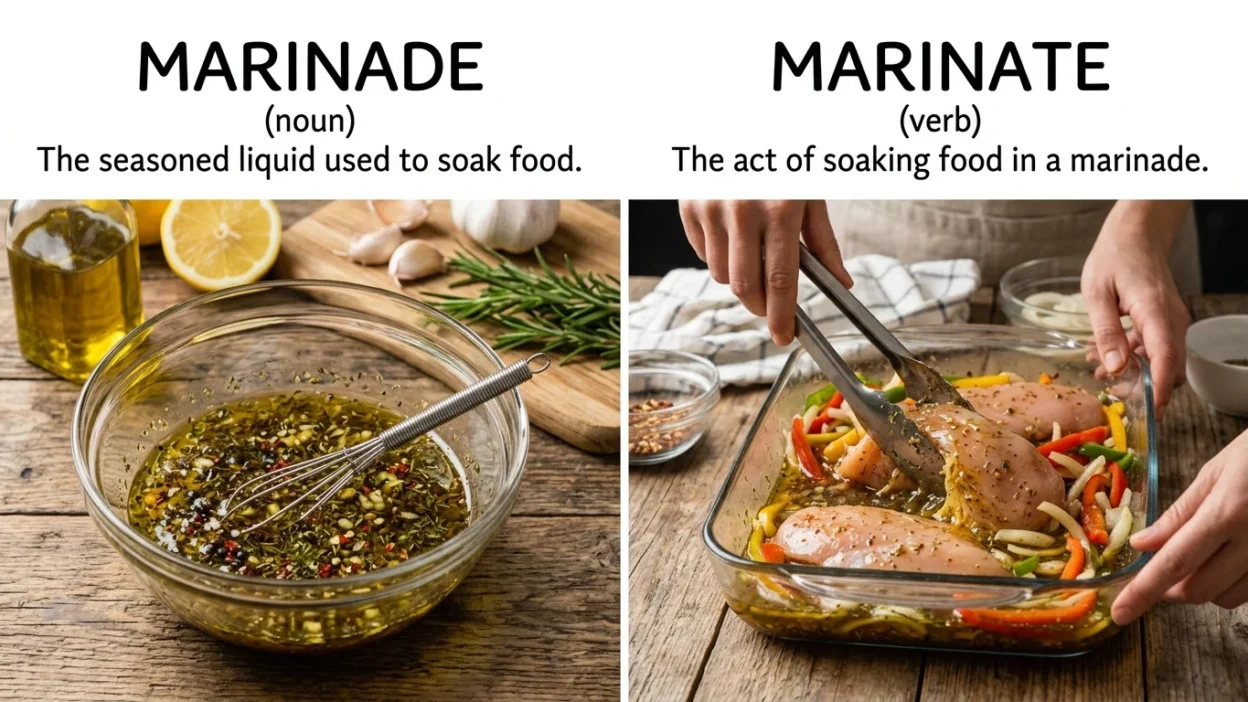
Have you ever wondered whether to write marinade or marinate? These two English words look and sound similar, so it is easy to mix them up. However, they have different meanings and grammatical uses. Knowing the difference can help you write more clearly, especially when discussing cooking, recipes, food preparation, and everyday activities.
The main difference between marinade and marinate is simple: marinade is a noun, while marinate is a verb. A marinade is a seasoned liquid used to add flavor and sometimes tenderize food. To marinate means to soak food in that liquid for a period of time. For example, you prepare a marinade with olive oil, lemon juice, and herbs, then marinate chicken in it before cooking. Once you understand how each word works, choosing the correct spelling becomes much easier.
Quick Answer: Marinade vs. Marinate
Marinade is a noun that refers to a seasoned liquid used to flavor food before cooking. Marinate is a verb that means soaking food in a marinade. For example, you make a marinade for chicken, then marinate the chicken for two hours. The simple rule is: marinade is the mixture, and marinate is the action.
Why Do People Confuse Marinade and Marinate?
People often confuse marinade and marinate because both words are connected to the same cooking process. They have similar spellings, share almost the same pronunciation, and are commonly used when preparing meat, fish, vegetables, and other foods.
Another reason for the confusion is that both words appear in recipes and cooking instructions. Someone might write, “Prepare the chicken marinade,” and then read, “Marinate the chicken overnight.” Without understanding their grammatical roles, it is easy to use one word instead of the other.
The easiest way to remember the difference is to identify what you are describing:
- Marinade: The liquid or mixture used to flavor food.
- Marinate: The action of soaking food in that mixture.
First Word: What Does Marinade Mean?
Marinade (noun) means a seasoned liquid or mixture in which food is soaked before cooking to add flavor and, in some cases, help tenderize it.
A marinade commonly contains ingredients such as oil, vinegar, lemon juice, herbs, spices, garlic, salt, and other seasonings. The ingredients depend on the recipe and the type of food being prepared.
For example, a simple chicken marinade might include olive oil, lemon juice, garlic, black pepper, and salt. You combine these ingredients to create a flavorful mixture.
Examples of Marinade in Sentences
- This chicken marinade contains garlic, lemon juice, and olive oil.
- I prepared a spicy marinade for the grilled fish.
- The beef marinade gives the meat a rich flavor.
- She shared her favorite homemade marinade recipe.
- You can prepare a simple marinade with vinegar and herbs.
What Are the Different Types of Marinades?
Marinades can contain different ingredients depending on the flavor and cooking method.
- Acidic marinade: Contains ingredients such as lemon juice, vinegar, or yogurt.
- Oil-based marinade: Uses olive oil or another cooking oil with herbs and spices.
- Herb marinade: Combines fresh or dried herbs with other seasonings.
- Spicy marinade: Includes chili, pepper, garlic, and other hot spices.
A marinade does not always need to contain every ingredient. Even a simple mixture can add plenty of flavor.
Second Word: What Does Marinate Mean?
Marinate (verb) means to soak or coat food in a seasoned liquid or mixture for a certain period before cooking.
When you marinate food, you allow it to absorb flavors from the ingredients in the marinade. Depending on the recipe, this process may also affect the food’s texture.
For example, when you place chicken in a mixture of lemon juice, olive oil, garlic, and spices for two hours, you are marinating the chicken.
Examples of Marinate in Sentences
- I marinate chicken before grilling it.
- You should marinate the beef for several hours.
- She likes to marinate fish with lemon juice.
- We marinated the vegetables before roasting them.
- Let the chicken marinate in the refrigerator overnight.
Different Forms of Marinate
Marinate is a regular verb, so its forms follow a common English spelling pattern.
| Verb Form | Word | Example |
| Base form | Marinate | I marinate the chicken. |
| Third-person singular | Marinates | She marinates the fish. |
| Past tense | Marinated | He marinated the beef. |
| Past participle | Marinated | The chicken has marinated for two hours. |
| Present participle | Marinating | They are marinating the vegetables. |
Remember that marinade is the noun, while marinate is the verb. Their grammatical functions are different even though their meanings are closely connected.
Marinade vs. Marinate: Comparison Table
The following table explains the main differences between these two words.
| Feature | Marinade | Marinate |
| Part of speech | Noun | Verb |
| Meaning | Seasoned liquid or mixture | To soak food in a seasoned mixture |
| Purpose | Adds flavor to food | Describes the preparation process |
| Usage | Names something | Describes an action |
| Example | The marinade smells delicious. | Marinate the chicken. |
| Word family | Marinades | Marinated, marinating |
Simple difference: Marinade is what you use, and marinate is what you do.
When Should You Use Marinade or Marinate?
Choosing the correct word becomes easy when you understand the purpose of your sentence.
When to Use Marinade
Use marinade when you are talking about the actual liquid, seasoning mixture, or recipe used to prepare food.
Examples:
- I need a new marinade for grilled chicken.
- This marinade tastes delicious.
- The recipe includes a homemade marinade.
- Add more garlic to the marinade.
If you can replace the word with “seasoned liquid” or “mixture,” marinade is usually correct.
When to Use Marinate
Use marinate when you are describing the action of soaking or coating food in a seasoned mixture.
Examples:
- Marinate the chicken for two hours.
- I always marinate beef before grilling.
- You should marinate the fish before baking.
- Let the vegetables marinate in the sauce.
If you can replace the word with “soak in a seasoned mixture,” marinate is usually the correct choice.
15 Examples of Marinade and Marinate in Sentences
Seeing both words in everyday sentences can help you understand how they work.
Examples Using Marinade
- My mother makes a delicious marinade for grilled chicken.
- The marinade contains fresh lemon juice and garlic.
- This recipe requires a simple olive oil marinade.
- The beef marinade gives the meat a wonderful flavor.
- I added black pepper to the marinade.
- A yogurt marinade works well in many chicken recipes.
- The chef prepared a special marinade for the fish.
Examples Using Marinate
- You should marinate chicken before putting it on the grill.
- I usually marinate beef overnight in the refrigerator.
- She likes to marinate vegetables with olive oil and herbs.
- We marinated the fish with lemon and garlic.
- Let the chicken marinate for at least 30 minutes.
- He is marinating the meat for dinner.
- They marinated the tofu in soy sauce.
- You can marinate shrimp before cooking it.
Examples Using Both Words Together
Here are additional examples showing how both words can appear naturally in one sentence:
- Prepare a lemon marinade and marinate the chicken for one hour.
- This spicy marinade will help flavor the beef when you marinate it.
- Make your favorite marinade before you marinate the vegetables.
- The chef created a special marinade and used it to marinate fresh fish.
Common Mistakes When Using Marinade and Marinate
Even experienced English speakers sometimes mix up these words. Here are some common mistakes and their correct forms.
| Incorrect Sentence | Correct Sentence |
| I will marinade the chicken. | I will marinate the chicken. |
| This marinate tastes delicious. | This marinade tastes delicious. |
| She prepared a chicken marinate. | She prepared a chicken marinade. |
| Let the meat marinade overnight. | Let the meat marinate overnight. |
| I need to make a new marinate. | I need to make a new marinade. |
Why Are These Sentences Incorrect?
The mistakes happen because the writer uses a noun where a verb is needed or a verb where a noun is needed.
For example:
- “I will marinade the chicken” is incorrect because the sentence needs an action word. The correct verb is marinate.
- “This marinate tastes delicious” is incorrect because the sentence refers to a mixture. The correct noun is marinade.
Always check whether your sentence describes a thing or an action.
Easy Memory Trick: How to Remember the Difference
A simple memory trick can help you remember marinade vs. marinate without memorizing complicated grammar rules.
Marinade = Mixture
Both words contain the idea of something prepared or used in cooking. Think of marinade as the actual sauce or seasoned liquid.
Marinate = Action
Think of marinate as the action you perform when placing food into the mixture.
Remember this simple formula:
- Make a marinade.
- Marinate the food.
- Cook the food.
For example, you make a garlic marinade, marinate the chicken in it, and then cook the chicken.
This three-step process makes the difference easy to understand.
Marinade vs. Marinate in American and British English
The difference between marinade and marinate is generally the same in American and British English.
Both varieties use:
- Marinade as a noun.
- Marinate as a verb.
There is no major spelling difference between American and British English for these two words.
| English Variety | Noun | Verb |
| American English | Marinade | Marinate |
| British English | Marinade | Marinate |
For example, an American recipe might say, “Prepare a marinade for the chicken,” while a British recipe might use the same sentence.
Both varieties also use expressions such as “marinate overnight” and “homemade marinade.”
Similar Words Related to Marinade and Marinate
Understanding related cooking words can improve your vocabulary and help you communicate more naturally.
1. Season
Season means adding salt, pepper, herbs, or spices to food to improve its flavor.
Example: Season the chicken with salt and black pepper.
2. Soak
Soak means keeping something in a liquid for a period of time.
Example: Soak the vegetables in water before cooking.
3. Tenderize
Tenderize means making meat softer and easier to chew.
Example: Some marinades help tenderize meat.
4. Brine
Brine is a mixture of salt and water, sometimes with additional ingredients, used to prepare food.
Example: The chef placed the turkey in a saltwater brine.
5. Sauce
A sauce is a liquid or semi-liquid mixture served with food or used during cooking.
Example: Add the sauce to the cooked vegetables.
Although these words are related to food preparation, they do not have exactly the same meanings as marinade and marinate.
Final Verdict: Marinade or Marinate?
The difference between marinade and marinate is based on their grammatical functions.
Marinade is a noun that describes the seasoned liquid or mixture used to flavor food. Marinate is a verb that describes the action of soaking food in that mixture before cooking.
For example, “I prepared a marinade for the chicken” is correct because marinade names the mixture. “I will marinate the chicken” is also correct because marinate describes the action.
When writing recipes, cooking instructions, or everyday sentences, remember that marinade is the mixture and marinate is the process. This simple distinction will help you avoid common spelling and grammar mistakes.
FAQs (FAQs)
1. What is the main difference between marinade and marinate?
Marinade is a noun that means a seasoned liquid used to flavor food. Marinate is a verb that means soaking food in that liquid before cooking. One names the mixture, while the other describes the action.
2. Is marinade a noun or a verb?
Marinade is a noun. It refers to the seasoned liquid or mixture used to prepare food before cooking.
Example: The chicken marinade contains lemon juice, garlic, and olive oil.
3. Is marinate a noun or a verb?
Marinate is a verb. It describes the process of soaking or coating food in a seasoned mixture.
Example: Marinate the chicken for two hours before grilling.
4. Is it correct to say marinade the chicken?
No. In standard English, “marinade the chicken” is incorrect when you mean soaking it in a seasoned mixture. The correct expression is “marinate the chicken.”
5. Can marinade and marinate be used in the same sentence?
Yes. Both words can appear naturally in the same sentence.
Example: Prepare a garlic marinade and marinate the chicken for one hour before cooking.
6. How long should you marinate food?
The appropriate marinating time depends on the food and recipe. Some foods need only 15 to 30 minutes, while larger cuts of meat may need several hours. Always follow a reliable recipe and keep perishable food in the refrigerator while marinating.
7. Is marinade spelled differently in American and British English?
No. Both American and British English use the spelling marinade for the noun and marinate for the verb. The meanings and grammatical differences are also the same.
8. What is the easiest way to remember marinade vs. marinate?
Remember that marinade is the mixture and marinate is the action. You make a marinade and use it to marinate food. This simple rule helps you choose the correct word in everyday writing.
Remember This
- Marinade = Noun: The seasoned liquid or mixture used to flavor food.
- Marinate = Verb: The action of soaking food in a seasoned mixture.
- Correct example: Prepare a marinade and marinate the chicken.
- Common mistake: Writing “marinade the chicken” instead of “marinate the chicken.”
The easiest rule is to remember: You make a marinade, but you marinate food.
Conclusion
Understanding the difference between marinade and marinate is easier than it first appears. Although these words look and sound similar, they have different grammatical roles. Marinade is a noun that names the seasoned mixture used in food preparation, while marinate is a verb that describes soaking food in that mixture. Learning this simple distinction can improve your English vocabulary, spelling, and everyday communication.
The next time you read a recipe or write cooking instructions, remember to use marinade for the mixture and marinate for the action. For example, prepare a delicious marinade, marinate your chicken, and enjoy a flavorful meal. With a little practice, you will never confuse these two words again.