
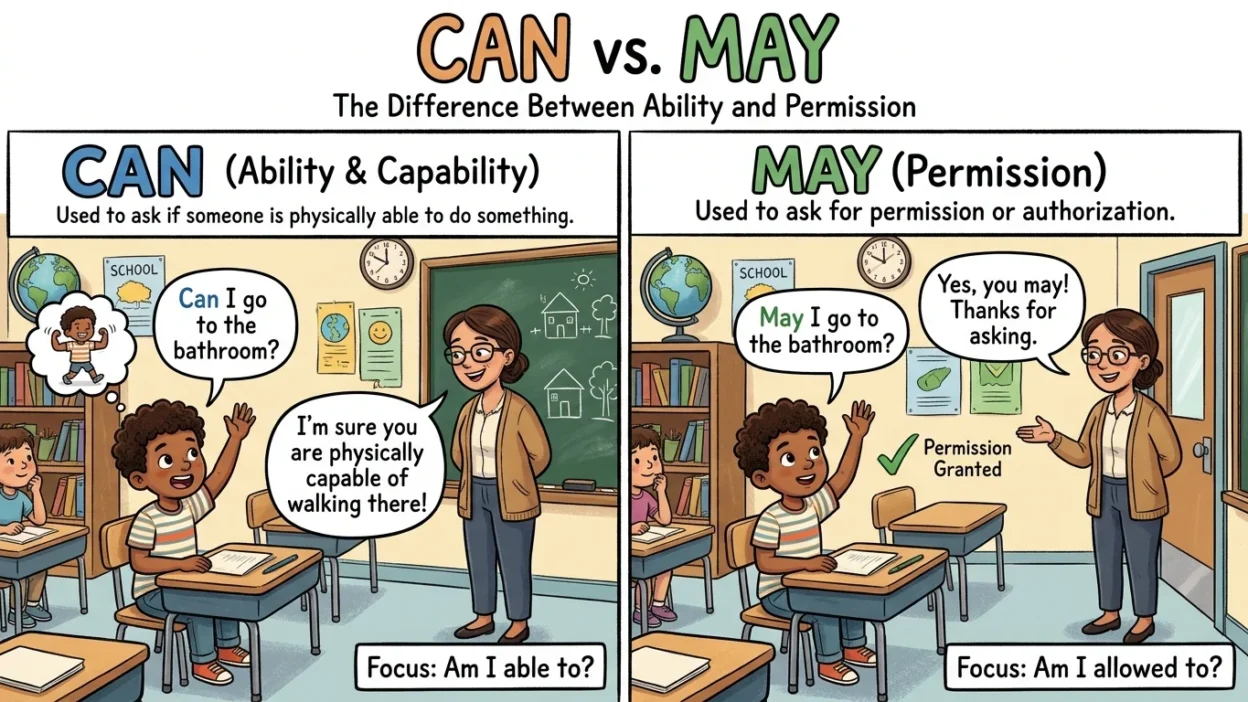
Both words can be used to talk about possibility, but they do not always express the same meaning. Understanding the difference between may and can will help you speak more naturally, write clearly, and choose the correct word in everyday conversations.
The main difference is that may usually expresses permission or possibility, while can generally expresses ability or possibility. For example, you might say, “May I come in?” when politely asking for permission, but “Can I swim?” when talking about your ability. Although these words sometimes overlap, knowing their basic uses makes English grammar much easier. In this guide, you will learn their meanings, grammatical rules, differences, examples, and common mistakes so you can use both words confidently.
Quick Answer: What Is the Difference Between May and Can?
May is generally used to express possibility or ask for permission politely. Can is mainly used to express ability, ask for permission in everyday conversation, or describe general possibility. For example, “May I leave?” is a polite request, while “I can drive” describes an ability.
Why Do People Confuse May and Can?
People often confuse may and can because both are modal verbs and can express possibility or permission.
For example:
- May: It may rain tomorrow.
- Can: It can rain during the winter.
Both sentences discuss the possibility of rain, but their meanings are slightly different.
May often describes something that is possible in a particular situation. Can can describe something that is generally possible or sometimes happens.
Another reason for confusion is that people commonly use can when asking for permission in informal conversations.
For example:
- May I use your phone?
- Can I use your phone?
Both sentences are correct. However, may sounds more formal and polite, while can sounds more natural in everyday conversation.
First Word: What Does May Mean?
May is a modal verb used to express possibility, permission, and sometimes wishes or hopes. It helps explain whether something might happen or whether someone is allowed to do something.
May is commonly used in formal conversations, professional communication, academic writing, and polite requests.
1. May for Permission
May is often used when asking for or giving permission.
Examples:
- May I enter the classroom?
- May I borrow your book?
- You may leave early today.
- May we sit here?
These sentences show that someone is asking for or receiving permission.
2. May for Possibility
May can describe something that is possible but not certain.
Examples:
- She may visit us tomorrow.
- It may snow tonight.
- He may be busy right now.
- They may arrive late.
In these examples, the speaker does not know for certain whether the events will happen.
3. May for Wishes and Blessings
May can also introduce a wish, hope, or blessing.
Examples:
- May God bless you.
- May you live a happy life.
- May peace be with you.
- May all your dreams come true.
This use is common in formal, literary, and religious language.
4. May in Negative Sentences
The negative form of may is may not.
Examples:
- You may not enter this room.
- She may not attend the meeting.
- It may not rain today.
Remember that may not can express either a lack of permission or a possibility that something will not happen. The context determines the meaning.
Second Word: What Does Can Mean?
Can is a modal verb mainly used to express ability, permission, and general possibility. It helps explain what someone is able to do or what is possible in a particular situation.
Can is widely used in everyday English, informal conversations, questions, and practical instructions.
1. Can for Ability
Can is commonly used to describe someone’s skills or abilities.
Examples:
- I can speak English.
- She can play the piano.
- He can drive a car.
- They can solve difficult problems.
These sentences explain what someone is capable of doing.
2. Can for Permission
Can is also used to ask for or give permission, especially in everyday conversations.
Examples:
- Can I use your computer?
- Can we go outside?
- You can take my chair.
- Can I open the window?
Although may is traditionally considered more formal, can is perfectly acceptable when asking for permission in modern English.
3. Can for Possibility
Can describes general possibilities, opportunities, or things that sometimes happen.
Examples:
- Driving can be dangerous.
- Exercise can improve your health.
- Winters can be very cold.
- Mistakes can happen to anyone.
These sentences describe situations that are possible in general.
4. Can in Negative Sentences
The negative form of can is cannot or can’t.
Examples:
- I cannot swim.
- She can’t attend the meeting.
- You cannot park here.
- He can’t understand the question.
Cannot is more common in formal writing, while can’t is widely used in everyday speech.
May vs. Can: Comparison Table
The following table explains the main differences between may and can.
| Feature | May | Can |
|---|---|---|
| Main meaning | Permission and possibility | Ability and possibility |
| Permission | Formal or polite | Casual or conversational |
| Ability | Not normally used | Commonly used |
| Possibility | Particular or uncertain possibility | General possibility |
| Formality | Often more formal | Often more conversational |
| Example | May I come in? | Can I swim? |
| Negative form | May not | Cannot or can’t |
| Past-related form | Might (in some contexts) | Could (in some contexts) |
Both words are modal verbs, so they follow similar grammatical patterns. However, their meanings and typical uses are different.
When Should You Use May and Can?
Choosing between may and can becomes easier when you understand the purpose of your sentence.
Use May When Asking Politely
Choose may when you want to sound especially polite or formal.
Examples:
- May I ask a question?
- May I speak with the manager?
- May I take a day off?
Use May When Something Is Possible
Use may when describing an uncertain event or situation.
Examples:
- She may come tomorrow.
- The weather may change.
- We may win the competition.
Use Can When Talking About Ability
Choose can when describing what someone knows how to do or is physically able to do.
Examples:
- I can cook.
- He can run fast.
- My sister can speak three languages.
Use Can in Everyday Permission Questions
Can is natural when asking friends, family members, or colleagues for permission in ordinary conversation.
Examples:
- Can I sit here?
- Can we watch television?
- Can I borrow your pen?
Use Can for General Possibility
Choose can when explaining what is generally possible.
Examples:
- Too much sugar can affect your health.
- Learning a new language can be challenging.
- Strong winds can damage buildings.
12 Examples of May and Can in Sentences
Here are practical examples that show how these modal verbs work in everyday English.
| No. | Sentence | Meaning |
|---|---|---|
| 1 | May I come inside? | Politely asking permission |
| 2 | I can speak English. | Expressing ability |
| 3 | It may rain tomorrow. | Expressing possibility |
| 4 | Can you help me? | Asking about ability or requesting help |
| 5 | You may leave now. | Giving permission |
| 6 | She can dance beautifully. | Describing ability |
| 7 | He may be sleeping. | Expressing uncertainty |
| 8 | Can I use your phone? | Asking permission |
| 9 | May God protect you. | Expressing a blessing |
| 10 | Children can learn quickly. | Describing general ability or possibility |
| 11 | They may arrive late. | Expressing uncertainty |
| 12 | We can finish this work today. | Expressing ability or practical possibility |
More Examples in Everyday Conversations
Conversation 1: Asking Permission
- Student: May I come in, teacher?
- Teacher: Yes, you may.
Conversation 2: Talking About Ability
- Ali: Can you play football?
- Ahmed: Yes, I can.
Conversation 3: Expressing Possibility
- Sara: Will it rain today?
- Maria: It may rain this evening.
Conversation 4: Informal Permission
- John: Can I borrow your notebook?
- Peter: Sure, you can.
These examples show how both words work naturally in different situations.
Common Mistakes When Using May and Can
English learners sometimes use may and can incorrectly because their meanings overlap. Here are some common mistakes and their corrections.
Mistake 1: Using May to Describe Ability
Incorrect: I may swim very well.
Correct: I can swim very well.
Explanation: Can describes someone’s ability to swim. May would suggest that swimming is possible or permitted in a particular context.
Mistake 2: Thinking Can Is Always Wrong for Permission
Incorrect belief: Can I open the window? is grammatically incorrect.
Correct: Can I open the window?
Explanation: Can is commonly used to ask for permission in modern everyday English. May is a more formal alternative.
Mistake 3: Using Can for Every Type of Possibility
Incorrect for a particular uncertain event: She can come tomorrow.
Better: She may come tomorrow.
Explanation: May is usually more suitable when you mean that someone might come but you are not certain.
Mistake 4: Adding To After May or Can
Incorrect: She may to visit us.
Correct: She may visit us.
Incorrect: He can to drive.
Correct: He can drive.
Explanation: Modal verbs are followed by the base form of the main verb without “to.”
Mistake 5: Adding -S to the Main Verb
Incorrect: He can speaks English.
Correct: He can speak English.
Incorrect: She may goes outside.
Correct: She may go outside.
Explanation: The main verb remains in its base form after a modal verb.
Easy Memory Trick: How to Remember May and Can
A simple memory trick can help you remember the difference between these two words.
Remember CAN = Capability.
Use can when talking about someone’s ability or something that is generally possible.
Examples:
- I can swim.
- She can sing.
- We can finish the work.
Remember MAY = Permission or Possibility.
Use may when asking politely for permission or describing something that might happen.
Examples:
- May I enter?
- It may rain.
- She may visit us.
A quick way to remember:
- Can = Can you do it?
- May = May I do it?
This simple trick will help you choose the correct word in most everyday situations.
May vs. Can in American and British English
May and can have almost the same basic meanings in American and British English. However, their use in everyday conversations can vary slightly depending on context and personal preference.
American English
In American English, can is very common when asking for permission.
Examples:
- Can I go outside?
- Can I borrow your car?
- Can we sit here?
May is also used, especially when someone wants to sound more polite or formal.
British English
In British English, both may and can are widely understood and accepted.
Examples:
- May I have a cup of tea?
- Can I use your telephone?
- May I ask you something?
May can sound more formal, while can is natural in casual conversation.
Important: The basic grammar rules are the same in both varieties of English. Neither American nor British English has a rule that makes can incorrect for ordinary permission requests.
Similar Words Related to May and Can
Understanding related modal verbs can make your English vocabulary stronger.
1. Might
Might expresses possibility or uncertainty.
Example: She might visit us tomorrow.
2. Could
Could is commonly used for past ability, polite requests, and possible situations.
Example: Could you help me with this question?
3. Must
Must expresses necessity, obligation, or a strong conclusion.
Example: You must wear a seat belt.
4. Should
Should expresses advice, recommendations, or expectations.
Example: You should study every day.
5. Would
Would is commonly used for polite requests, imagined situations, and repeated past actions.
Example: Would you like some tea?
These words are related to may and can because they are modal verbs, but each has its own meaning and purpose.
Final Verdict: May vs. Can
The main difference between may and can is their purpose. May is generally used for polite permission and uncertain possibility, while can is mainly used for ability, everyday permission, and general possibility.
For example, say “May I leave?” when making a polite request, and “I can drive” when describing an ability. Both words can be used to ask for permission, but may usually sounds more formal.
Once you understand these basic differences, choosing between may and can becomes much easier.
FAQs:
1. What is the main difference between may and can?
May is mainly used to express permission and possibility, while can usually expresses ability, permission in everyday conversation, and general possibility. For example, “May I enter?” is a polite request, while “I can swim” describes an ability.
2. Is may more polite than can?
Yes, may is traditionally considered more formal and polite when asking for permission. However, can is also acceptable in modern English and is commonly used in everyday conversations.
3. Can I use can instead of may?
Yes. You can use can instead of may when asking for permission in informal or everyday situations. For example, “Can I borrow your pen?” is correct. However, “May I borrow your pen?” sounds more formal.
4. Is may used for ability?
No, may is not normally used to describe someone’s ability. Can is the appropriate modal verb for expressing skills or abilities. For example, say “I can swim” rather than “I may swim” when describing your swimming ability.
5. Can may and can both express possibility?
Yes. Both modal verbs can express possibility, but they are used differently. May usually describes an uncertain or particular possibility, while can often describes general possibilities. For example, “It may rain tomorrow” and “It can rain heavily in winter.”
6. What is the negative form of may and can?
The negative form of may is may not. The negative form of can is cannot or can’t. For example, “She may not come today” expresses uncertainty, while “I cannot swim” expresses a lack of ability.
7. Which word should I use in formal writing: may or can?
It depends on the meaning of your sentence. Use may for formal permission requests and uncertain possibilities. Use can when describing abilities or general possibilities. Both words are correct in formal writing when used appropriately.
Remember This
- May = Polite permission and possibility.
- Can = Ability, everyday permission, and general possibility.
- May I…? = A polite way to ask permission.
- Can I…? = A natural way to ask permission in everyday English.
- I can… = Describes an ability.
- It may… = Describes something that might happen.
The easiest rule is to remember that can usually describes what someone is able to do, while may often describes what is allowed or what might happen.
Conclusion
Understanding the difference between may and can is an important step toward improving your English grammar and communication skills. Although both words can express permission and possibility, they have different common uses. May is generally preferred for polite requests and uncertain events, whereas can is commonly used to describe abilities and everyday permission.
Practice using these words in your daily conversations, emails, and written sentences. Remember that context matters when choosing between them. With regular practice and a clear understanding of their meanings, you will become more confident and c when using may and can in English.