Many English learners and even native speakers get confused between “hanged” and “hung.” These two words come from the same verb “hang,” but they are used in different situations.
The confusion happens because both words look correct, and both are used in daily English. But if you use the wrong one in the wrong situation, the sentence can sound strange or even incorrect.
The good news is that the rule is actually very simple. Once you understand it clearly, you will never mix them up again.
Quick Answer
Here is the easiest way to understand the difference:
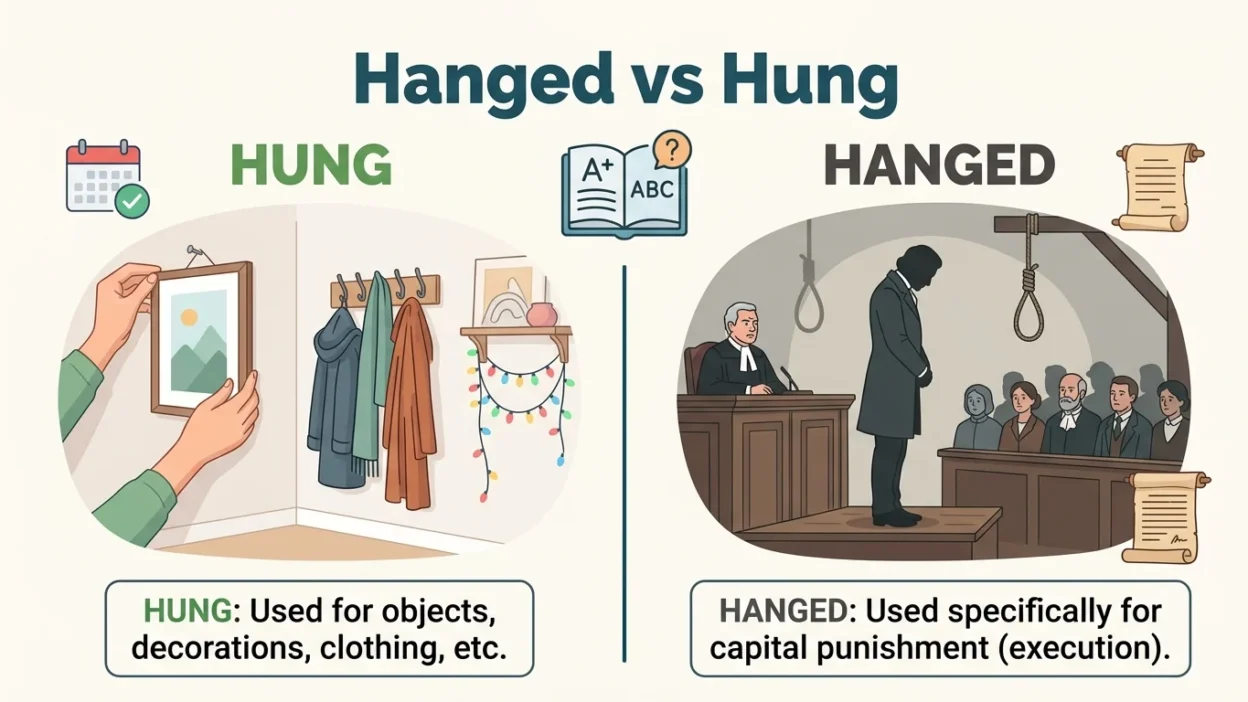
- Hung is used for most situations (general meaning of hanging something)
- Hanged is only used when someone is killed by hanging (execution or death penalty)
Simple summary:
- You hang a picture → hung
- You hang clothes → hung
- A criminal is hanged (in legal or historical context)
Simple Origin or Background
The verb “hang” is unusual in English because it has two past tense forms:
- Hung → the normal and most common form today
- Hanged → a special form used only for execution (death by hanging)
In older English, both forms were used more widely. Over time, English became more organized, and people started using:
- Hung for objects, things, and general use
- Hanged only for legal or historical death punishment
This change helped reduce confusion in writing and speaking.
Clear Explanation of the Difference
To understand the difference clearly, think about meaning, not spelling.
When we use “hung”
We use hung when something is placed, fixed, or suspended in the air.
Examples:
- I hung my jacket on the chair.
- She hung the painting on the wall.
- The flag was hung outside the school.
- He hung the lights for decoration.
In all these cases, nothing is related to death or punishment.
When we use “hanged”
We use hanged only when a person dies by hanging.
Examples:
- The criminal was hanged in the past.
- He was hanged for his crimes (historical/legal use).
- In old times, some prisoners were hanged.
Important point:
This word is almost only used in history books, law discussions, or old stories.
Comparison Table
| Situation | Correct Word | Example |
| Hanging clothes | Hung | I hung my shirt to dry |
| Hanging pictures | Hung | She hung a photo on the wall |
| Hanging decorations | Hung | They hung balloons for the party |
| Death by execution | Hanged | The prisoner was hanged |
| General objects | Hung | The keys were hung on a hook |
| Legal punishment (past) | Hanged | He was hanged for theft in history |
Which One to Use and When
If you are still unsure, just follow this simple rule:
Use “hung” in almost all situations
Ask yourself:
- Is it an object?
- Is it something you are placing or suspending?
- Is it normal daily use?
If yes → use hung
Use “hanged” only for death penalty
Ask yourself:
- Is it about a person being executed by hanging?
If yes → use hanged
Easy memory trick:
- Hung = things
- Hanged = humans (execution only)
This simple trick works for most learners.
Common Mistakes People Make
Many learners make small but common mistakes. Let’s fix them:
Mistake: Using “hanged” for objects
❌ I hanged my clothes on the line.
✔ I hung my clothes on the line.
Mistake: Using “hung” for execution
❌ The prisoner was hung in the past.
✔ The prisoner was hanged in the past.
Mistake: Thinking both mean the same
They do not mean the same in modern English. The meaning depends on the situation.
Mistake: Overthinking every sentence
Many students pause too long trying to choose. The rule is simple:
- If it’s not about death → use hung
Everyday Real Life Examples
Let’s see how people actually use these words in daily life.
In daily conversation
- I hung my bag on the door.
- He hung the mirror in his room.
- We hung colorful lights for Eid.
In school or student life
- The teacher hung charts on the wall.
- Students hung posters in the classroom.
In news or history
- The report said the criminal was hanged in the 1800s.
- The book describes how prisoners were hanged in ancient times.
In social media
- “Just hung my new painting in the room 😍”
- “They hung decorations everywhere for the event!”
In emails or formal writing
- The documents were hung in the exhibition hall.
- Historical records show the prisoner was hanged for treason.
Short Learning Section for Students and Beginners
If you are learning English, remember this simple learning guide:
Step 1: Think about the subject
- If it is a thing → hung
- If it is a person and death → hanged
Step 2: Practice simple sentences
Try these:
- I hung my shirt.
- She hung a photo.
- The man was hanged (history only).
Step 3: Avoid guessing
If you are unsure, default to hung, unless the sentence clearly talks about execution.
Step 4: Build memory with repetition
The more you see correct examples, the easier it becomes.
FAQ (Frequently Asked Questions)
Why do we have two words for “hang”?
Because English developed different forms over time. “Hung” became the normal form, and “hanged” stayed only for execution cases.
Can I use “hanged” for objects?
No. It is incorrect. Use “hung” for objects and things.
Is “hung” always correct?
Not always, but in most daily situations, yes. It is the safest choice.
Is “hanged” still used today?
Yes, but very rarely. It is mostly used in legal history or storytelling about the past.
What is the past tense of hang for clothes?
The correct past tense is hung. Example: I hung my clothes yesterday.
What is the easiest way to remember the difference?
Remember: hung = objects, hanged = execution only.
Can I say “he was hung” in modern English?
No, that is incorrect if you mean execution. You must say “he was hanged.”
Why does English keep such confusing words?
English has many historical rules that stayed over time. Some verbs developed special meanings like this one.
Conclusion
The difference between hanged and hung is simple once you understand the rule.
- Use hung for almost everything in daily life, especially objects like clothes, pictures, and decorations.
- Use hanged only when talking about a person being killed by hanging in a legal or historical context.
You do not need to memorize difficult grammar rules. Just remember one simple idea:
Hung is for things, and hanged is for execution.
With practice and regular use, this difference will become natural and easy for you.