
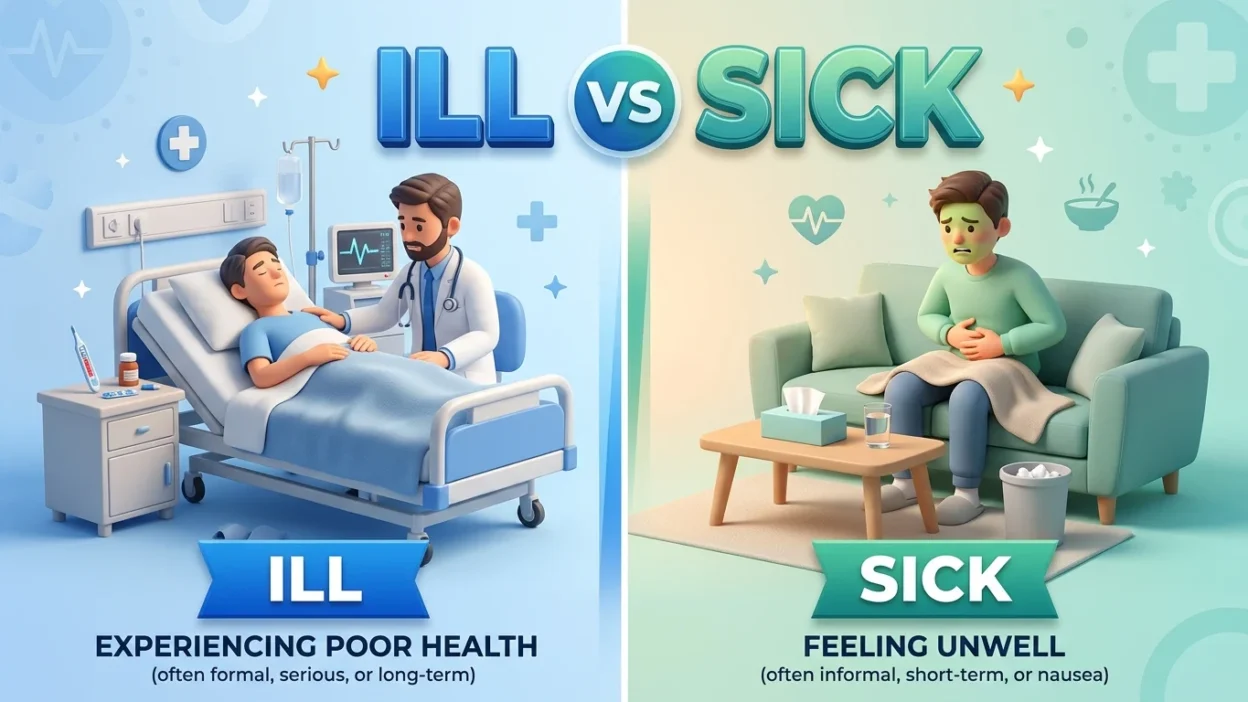
The words ill and sick both describe a person who is not feeling healthy. They are often used interchangeably, but they have slightly different meanings, usage patterns, and levels of formality. Understanding the difference between ill and sick can help you speak and write more naturally in English. Although both words refer to poor health, they are not always suitable in the same situations.
For example, you can say, “I feel sick today” or “I am ill today.” Both sentences are grammatically correct, but they may sound slightly different depending on the situation and the speaker’s variety of English. In American English, sick is more common in everyday conversation, while ill often sounds more formal. British English also uses both words, although certain expressions and sentence patterns are different. In this guide, you will learn their meanings, differences, correct usage, examples, and common mistakes.
Quick Answer: Ill vs. Sick
Ill and sick both mean experiencing poor health or having an illness. However, sick is more common in everyday American English and can also mean feeling nauseated. Ill often sounds more formal and is frequently used to describe someone who has a disease or health condition. Both words can function as adjectives.
Why Do People Confuse Ill and Sick?
People often confuse ill and sick because both describe someone who is not healthy. In many everyday situations, they communicate almost the same message.
For example:
- I am ill today.
- I am sick today.
Both sentences tell someone that you are not feeling well and may be unable to attend work or school.
However, there are some important differences:
- Formality: Ill often sounds more formal, while sick is more conversational.
- Nausea: Sick can describe someone who feels like vomiting.
- Common expressions: English speakers use expressions such as “sick leave,” “fall ill,” and “sick and tired.”
- Regional usage: American and British English sometimes prefer different expressions.
Learning these differences will help you choose the right word in different situations.
First Word: Ill
What Does Ill Mean?
Ill is an adjective that means suffering from an illness, disease, or health problem. It describes someone whose physical or mental health is not good.
The word is commonly used in formal conversations, medical discussions, news reports, and written English.
Examples:
- My grandfather is seriously ill.
- She was ill for several days.
- The doctor visited the ill patient.
- He became ill during the winter.
In these sentences, ill describes a person experiencing poor health.
How to Use Ill in a Sentence
You can use ill in several common sentence structures.
1. Ill after a linking verb
- My mother is ill.
- The child looks ill.
- He became ill yesterday.
2. Ill before a noun
- An ill patient needs medical attention.
- The hospital provides care for ill people.
- She visited her ill grandmother.
3. Common expressions with Ill
- Fall ill: Become sick.
- Seriously ill: Having a serious health condition.
- Mentally ill: Experiencing a mental health condition.
- Terminally ill: Having an illness that cannot be cured and is expected to cause death.
Example: He suddenly fell ill while traveling.
Second Word: Sick
What Does Sick Mean?
Sick is an adjective that means unwell, unhealthy, or affected by an illness. It is widely used in everyday English, especially in American English.
It can also describe a feeling of nausea, which means feeling as if you might vomit.
Examples:
- I feel sick today.
- My brother is sick with the flu.
- She stayed home because she was sick.
- The smell of the food made me feel sick.
In the last example, sick describes nausea rather than a specific disease.
How to Use Sick in a Sentence
Here are some common ways to use sick correctly.
1. Sick after a linking verb
- I am sick today.
- She feels sick.
- My father became sick last night.
2. Sick before a noun
- He is taking care of his sick child.
- The sick woman needs a doctor.
- I visited my sick friend.
3. Common expressions with Sick
- Get sick: Become unwell.
- Feel sick: Experience nausea or poor health.
- Sick leave: Time away from work because of illness.
- Sick day: A day off because of illness.
- Sick and tired: Extremely annoyed or frustrated.
Example: I feel sick, so I am going to stay home today.
Ill vs. Sick: Comparison Table
| Feature | Ill | Sick |
| Meaning | Having an illness or poor health | Having an illness or feeling unwell |
| Part of speech | Adjective | Adjective |
| Formality | Often more formal | Usually more conversational |
| American English | Less common in casual speech | Very common |
| British English | Common | Common |
| Nausea meaning | Not normally used this way | Commonly used |
| Example | She is seriously ill. | I feel sick. |
| Common expression | Fall ill | Get sick |
Main difference: Ill generally emphasizes being unwell or having an illness, while sick is more flexible and can also describe nausea.
When Should You Use Ill or Sick?
Choosing between ill and sick depends on the meaning, situation, and type of English you are using.
Use Ill When:
- You want to sound more formal.
- You are describing someone with a serious health condition.
- You are writing a formal report or medical-related text.
- You are using expressions such as “fall ill” or “seriously ill.”
Examples:
- The patient is seriously ill.
- Several people fell ill after the outbreak.
- Her father has been ill for two weeks.
Use Sick When:
- You are speaking casually with friends or family.
- You want to describe everyday health problems.
- You are talking about nausea.
- You are using expressions such as “sick leave” or “get sick.”
Examples:
- I am sick today.
- She got sick after eating too much.
- My son is feeling sick.
- I need to take a sick day.
Can You Use Ill and Sick Interchangeably?
Yes, you can use them interchangeably in many situations.
For example:
- He is ill.
- He is sick.
Both sentences are correct.
However, they are not interchangeable in every expression. For example, “I feel sick” commonly means that you feel nauseated, while “I feel ill” usually communicates a more general feeling of poor health.
15 Examples of Ill and Sick in Sentences
The following examples show how these words work in everyday English.
Examples Using Ill
- My grandmother has been ill for three days.
- The doctor examined the seriously ill patient.
- He fell ill during his business trip.
- She could not attend school because she was ill.
- The hospital provides special care for ill children.
- His father became seriously ill last month.
- Several workers fell ill after eating contaminated food.
- The nurse looked after the ill woman.
Examples Using Sick
- I am feeling sick this morning.
- My little brother is sick with a cold.
- She stayed home because she was sick.
- The moving car made me feel sick.
- He took a sick day from work.
- My friend got sick after eating street food.
- I am sick and tired of waiting for the bus.
These examples demonstrate that both words describe poor health, but sick has additional meanings and everyday expressions.
Common Mistakes When Using Ill and Sick
Even English learners sometimes use these words incorrectly. Here are some mistakes to avoid.
1. Using Ill to Describe Nausea
Incorrect: I feel ill because the bus makes me want to vomit.
Better: I feel sick because the bus makes me want to vomit.
Explanation: Sick is the more natural word when describing nausea.
2. Forgetting the Verb To Be
Incorrect: She sick today.
Correct: She is sick today.
Explanation: Use a suitable linking verb, such as is, am, or are, when making this type of sentence.
3. Using Sick and Ill as Nouns
Incorrect: The sick is in the hospital.
Better: The sick people are in the hospital.
Explanation: Sick and ill are normally adjectives. You can use “the sick” as a collective expression, but the construction may sound formal.
4. Confusing Sick Leave and Ill Leave
Incorrect: I need to apply for ill leave.
Correct: I need to apply for sick leave.
Explanation: Sick leave is the standard expression for time away from work because of illness.
5. Using the Wrong Expression
Incorrect: He became sick and tired of his illness.
Better: He was sick and tired of waiting.
Explanation: “Sick and tired of” is an idiom that means extremely annoyed or frustrated.
Memory Trick: How to Remember Ill vs. Sick
A simple memory trick can help you remember the difference.
- Ill = Illness: Think of a health condition or a formal description of poor health.
- Sick = Stomach or sickness: Remember that sick can describe nausea as well as general illness.
For example:
- My uncle is seriously ill. (A health condition)
- I feel sick after eating too much. (Nausea)
Remember that this is a learning trick, not a strict grammatical rule. Both words can describe general poor health.
Ill vs. Sick in American and British English
Both ill and sick are correct in American and British English. However, their frequency and preferred expressions can vary.
American English
In American English, sick is especially common in everyday conversations.
Examples:
- I am sick today.
- My daughter got sick yesterday.
- He called in sick at work.
Americans also commonly use ill in formal or serious contexts.
British English
In British English, both words are widely understood and used.
Examples:
- She has been ill for a week.
- I feel sick.
- He fell ill while traveling.
British English also uses sick to describe nausea, just as American English does.
Important note: The difference is mainly about usage and preference, not completely different meanings. Both words are acceptable in both varieties of English.
Similar Words: Ill, Sick, Unwell, and Unhealthy
English has several words that describe poor health. Understanding their differences can improve your vocabulary.
| Word | Meaning | Example |
| Ill | Experiencing an illness | My father is ill. |
| Sick | Unwell or nauseated | I feel sick. |
| Unwell | Not feeling healthy | She is feeling unwell. |
| Unhealthy | Not good for health | Eating too much sugar can be unhealthy. |
| Ailing | Suffering from poor health | He cares for his ailing mother. |
| Diseased | Affected by a disease | The plant has diseased leaves. |
Ill vs. Unwell
Ill often suggests an illness or health problem, while unwell is a softer and more general way of saying that someone does not feel healthy.
Example: I am feeling unwell today.
Sick vs. Unhealthy
Sick usually describes someone who is currently unwell, while unhealthy describes something that is harmful to health or not in good condition.
Example: Smoking is an unhealthy habit.
Final Verdict: Ill vs. Sick
The main difference between ill and sick is their usage and meaning in particular contexts.
Ill is often more formal and describes someone who has an illness or health problem. Sick is more common in everyday conversations and can also mean feeling nauseated.
Both words are correct in American and British English. If you are talking casually, sick is usually a natural choice. If you are discussing a serious medical condition or writing formally, ill may be more appropriate.
Frequently Asked Questions (FAQs)
1. What is the main difference between ill and sick?
The main difference is that ill often sounds more formal and describes someone experiencing an illness, while sick is more common in everyday English and can also mean feeling nauseated. Both words can describe poor health.
2. Is it correct to say I am ill or I am sick?
Yes, both sentences are grammatically correct. “I am ill” and “I am sick” communicate that you are not feeling healthy. The second expression is especially common in casual American English.
3. Is sick more common than ill in American English?
Yes. Sick is generally more common in everyday American conversations. However, ill is also widely used, especially in formal writing, medical contexts, and descriptions of serious health conditions.
4. Does ill mean vomiting?
No. Ill generally means having an illness or experiencing poor health. Sick is commonly used to describe nausea or the feeling that you might vomit.
5. Can I use ill and sick in the same sentence?
Yes. You can use both words in one sentence when they describe different things.
Example: My brother was seriously ill, and I felt sick during the journey.
6. Which word is more formal, ill or sick?
Ill is generally considered more formal than sick. For example, “The patient is seriously ill” sounds more formal than “The patient is really sick.”
7. Do British people say sick or ill?
British people use both words. Ill is common when describing general illness, while sick is frequently used in everyday speech and to describe nausea. The correct choice depends on the context.
8. Is sick leave correct or ill leave?
Sick leave is the correct and widely accepted expression. It refers to approved time away from work because of illness. “Ill leave” is not the standard expression.
Remember This
- Ill: Usually a more formal word for having an illness or poor health.
- Sick: A common everyday word for being unwell or feeling nauseated.
- Sick leave: The standard expression for time off work because of illness.
- Fall ill: A common expression meaning to become ill.
- American English: Sick is especially common in everyday conversations.
- British English: Both ill and sick are commonly used.
Conclusion
Understanding the difference between ill and sick makes English communication easier and more natural. Both words describe poor health, but they have different usage patterns. Ill is generally more formal, while sick is more common in everyday conversations and can also describe nausea. Learning their meanings, expressions, and sentence structures will help you use them correctly.
The easiest way to remember the difference is to associate ill with illness and sick with everyday sickness or nausea. Whether you speak American or British English, both words are useful parts of your vocabulary. Practice using them in different sentences, and you will become more confident in choosing the right word.