Many English learners get confused by “sown” and “sewn” because these two words look very similar.
They are both past forms of verbs.
They are both used in English writing.
And they differ by only one letter.
Because of this, many people use the wrong one by mistake.
The good news is that the difference is actually very simple.
Once you understand what each word means and where it comes from, it becomes easy to know which one to use.
This guide will explain everything in very simple English so you can understand it quickly and remember it easily.
Quick Answer
Here is the simple answer:
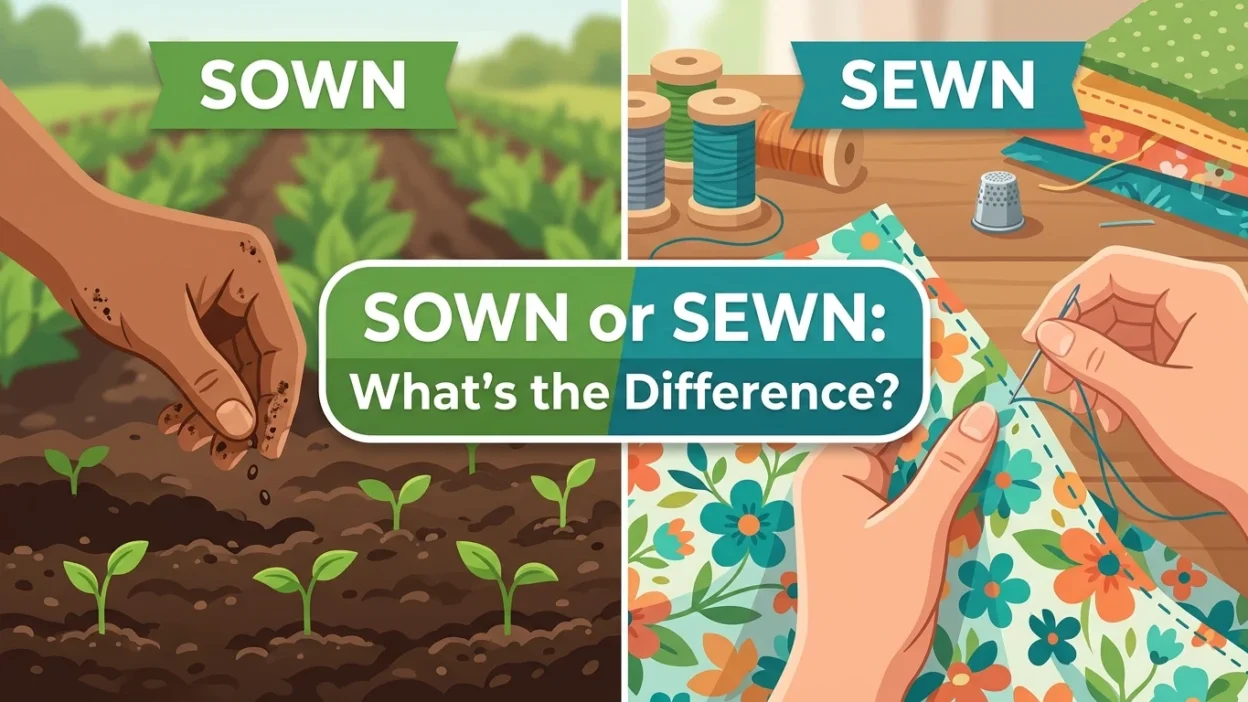
- Sown is related to planting seeds
- Sewn is related to stitching cloth or fabric
Think of it like this:
- Sown = seeds
- Sewn = stitching
Examples:
- The farmer has sown the wheat.
- My mother has sewn a new dress.
If you are talking about plants, farming, or seeds, use sown.
If you are talking about clothes, fabric, or stitching, use sewn.
Where Do These Words Come From?
To understand the difference, it helps to know their base verbs.
Sown comes from “sow”
The verb sow means:
to plant seeds in the ground
Example:
- Farmers sow corn every spring.
Past forms:
- Present: sow
- Past: sowed
- Past participle: sown
Example:
- The seeds were sown yesterday.
Sewn comes from “sew”
The verb sew means:
to join cloth or fabric using a needle and thread
Example:
- She likes to sew dresses.
Past forms:
- Present: sew
- Past: sewed
- Past participle: sewn
Example:
- The shirt was sewn by hand.
The Clear Difference Between Sown and Sewn
The difference is based on meaning.
Use “sown” for planting
This is about:
- Seeds
- Farming
- Gardens
- Growth
- Planting
Examples:
- The farmer has sown rice.
- The field was sown in April.
- Seeds were sown before the rain.
Use “sewn” for stitching
This is about:
- Clothes
- Fabric
- Needles
- Thread
- Making or repairing cloth
Examples:
- The button was sewn back on.
- The dress was carefully sewn.
- She had sewn the blanket herself.
Comparison
| Feature | Sown | Sewn |
| Base verb | Sow | Sew |
| Main meaning | Planting seeds | Stitching fabric |
| Used with | Farms, gardens, seeds | Clothes, cloth, thread |
| Example | Seeds were sown | The dress was sewn |
| Easy memory tip | Think of soil | Think of shirt |
This table makes it easy to remember the difference.
Which One Should You Use and When?
Here is a simple way to choose.
Use sown when talking about nature
Examples:
- The farmer has sown corn.
- The seeds were sown last week.
- Hope was sown in their hearts.
You may also see sown used in a non literal way.
Example:
- The speech has sown fear among people.
This means fear was “planted” like a seed.
Use sewn when talking about cloth or repair
Examples:
- The hole was sewn shut.
- Her wedding dress was sewn by hand.
- The patch was sewn onto the jacket.
Any time there is stitching involved, sewn is correct.
Common Mistakes People Make
Many learners mix these words because they sound similar.
Here are common mistakes.
Mistake 1: Using “sewn” for seeds
❌ The farmer has sewn wheat.
✅ The farmer has sown wheat.
Why?
Wheat is planted, not stitched.
Mistake 2: Using “sown” for clothes
❌ My shirt was sown yesterday.
✅ My shirt was sewn yesterday.
Why?
Shirts are stitched, not planted.
Mistake 3: Guessing based on sound
Both words can sound similar in fast speech.
Always focus on the meaning.
Ask yourself:
Am I talking about seeds or stitching?
That will give you the correct answer.
Everyday Real Life Examples
Here are examples from daily life.
In Emails
Sown
- The garden beds were sown last weekend.
Sewn
- Your school badge has been sewn onto the uniform.
In News Writing
Sown
- Farmers have sown crops after the first rain.
Sewn
- Traditional garments were sewn by local workers.
On Social Media
Sown
- We’ve finally sown our vegetable garden!
Sewn
- I just finished a hand sewn bag.
In Daily Conversation
- The seeds were sown this morning.
- The curtains were sewn by my aunt.
A Simple Learning Trick for Students
Here is an easy memory trick.
Sown = Soil
Both words begin with “So”
- Sown
- Soil
This helps you remember that sown is about planting.
Sewn = Shirt
Both words connect to clothing.
- Sewn
- Shirt
This helps you remember that sewn is about stitching.
Quick Practice
Choose the correct word.
- The flowers were ___ in spring.
Answer: sown - The pillow cover was ___ by hand.
Answer: sewn - The farmer has ___ new seeds.
Answer: sown - The torn pocket was ___ carefully.
Answer: sewn
Practice like this helps the difference stay in your memory.
FAQ
1. Is it “sown” or “sewn” for planting?
Use sown.
Example:
The seeds were sown in the field.
2. Is it “sown” or “sewn” for clothes?
Use sewn.
Example:
The jacket was sewn by machine.
3. Why are these words confusing?
They look and sound similar.
Also, both are past participles of irregular verbs.
4. Can “sown” be used in a non plant meaning?
Yes.
It can mean spreading an idea or feeling.
Example:
The rumor sown panic.
More naturally:
The rumor sowed panic.
5. Is “sewed” also correct?
Yes.
“Sewed” is the simple past form.
Example:
- She sewed the dress yesterday.
“Sewn” is often used with has, have, had, was, were.
Example:
- The dress has been sewn.
6. Is “sowed” also correct?
Yes.
“Sowed” is the simple past.
Example:
- He sowed seeds yesterday.
“Sown” is usually the past participle.
Example:
- The seeds have been sown.
7. How can I remember the difference fast?
Use this memory rule:
Sown = Seeds
Sewn = Stitching
8. Are these words used often?
Yes.
You will often see:
- Sown in farming, gardening, and writing
- Sewn in clothing, fashion, and repair
Conclusion
The difference between sown and sewn is simple once you connect each word to its meaning.
Use sown when talking about planting seeds.
Use sewn when talking about stitching fabric.
The easiest way to remember is:
- Sown = soil and seeds
- Sewn = shirts and stitching
Whenever you are unsure, ask yourself one simple question:
Am I talking about planting or stitching?
If it is about planting, choose sown.
If it is about stitching, choose sewn.
That one question will help you choose the right word every time.