Many people feel confused when they see both honor and honour in books, emails, social media posts, and school work. One spelling has a “u,” and the other does not. Because both words look correct, learners often wonder which one they should use.
The good news is simple: both spellings are correct. The difference mostly depends on the type of English you are using.
This guide will explain everything in very easy English so you can understand the difference clearly and use the right spelling with confidence.
Quick Answer
Here is the simple answer:
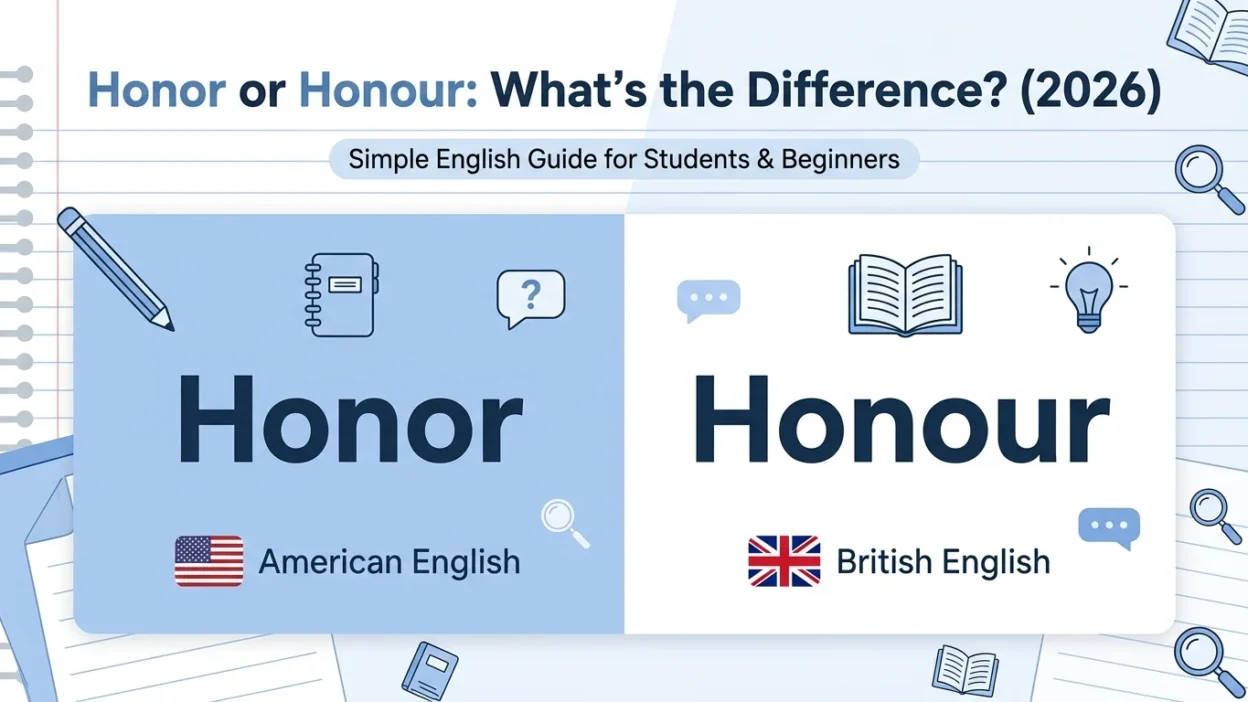
- Honor = American English spelling
- Honour = British English spelling
- Both words have the same meaning
- Both are pronounced the same way
- You should choose one spelling style and stay consistent
Example:
- American English: “It is an honor to meet you.”
- British English: “It is an honour to meet you.”
Both sentences are correct.
Simple Background and Origin
The word comes from an old Latin word called honor. Over time, English changed in different countries.
In American English
Many words became shorter and simpler in spelling. Because of this, Americans usually removed the “u” from words like:
- color
- favor
- honor
In British English
The older spelling style stayed the same, so the “u” remained:
- colour
- favour
- honour
This is why we now have two correct spellings.
What Does “Honor” or “Honour” Mean?
Both words mean:
- respect
- pride
- honesty
- showing admiration for someone
- doing something special for another person
Simple examples:
- “We honor our teachers.”
- “She received an honour for bravery.”
- “It was an honor to help you.”
The meaning never changes. Only the spelling changes.
The Main Difference Between Honor and Honour
The only real difference is the type of English being used.
Use “Honor” if you are writing in:
- American English
- United States schools
- American companies
- US newspapers or websites
Use “Honour” if you are writing in:
- British English
- United Kingdom schools
- Canada (often British style)
- Australia
- New Zealand
Both are accepted in English around the world.
Easy Comparison
| Feature | Honor | Honour |
| English Style | American English | British English |
| Correct Spelling? | Yes | Yes |
| Meaning | Respect or admiration | Respect or admiration |
| Pronunciation | Same | Same |
| Common Countries | United States | UK, Canada, Australia |
| Example Sentence | “It is an honor.” | “It is an honour.” |
Which One Should You Use?
The best choice depends on your audience, school, or country.
Use “Honor” when:
- Writing for American readers
- Studying American English
- Applying to US colleges
- Writing in American style
Use “Honour” when:
- Writing for British readers
- Studying British English
- Living in the UK or Australia
- Following British spelling rules
Important Tip
Do not mix both spellings in the same piece of writing.
Wrong:
- “It is an honor and a great honour.”
Better:
- “It is an honor and a great privilege.”
OR - “It is an honour and a great privilege.”
Stay consistent from beginning to end.
Other Words Like Honor and Honour
Many English words follow the same spelling pattern.
| American English | British English |
| color | colour |
| favor | favour |
| labor | labour |
| neighbor | neighbour |
| behavior | behaviour |
If you understand “honor” and “honour,” you can also understand these words more easily.
Common Mistakes People Make
1. Mixing American and British spelling
This is one of the most common mistakes.
Example:
- “My favourite color is blue.”
This sentence mixes British spelling (favourite) and American spelling (color).
It is better to choose one style.
Correct American English:
- “My favorite color is blue.”
Correct British English:
- “My favourite colour is blue.”
2. Thinking one spelling is wrong
Some learners believe “honour” is incorrect because they mostly see “honor” online. Others think the opposite.
Remember:
- both are correct
- the difference is regional
3. Changing spelling in formal writing
Students sometimes switch spellings during essays or assignments.
Teachers usually want one consistent style.
4. Pronouncing them differently
Both words sound the same.
Pronunciation:
- ON-er
The “u” is silent.
Everyday Real Life Examples
Here are simple examples from daily life.
In Emails
American English:
“It was an honor speaking with you today.”
British English:
“It was an honour speaking with you today.”
In News Headlines
American Style:
“Veteran Receives Honor Award”
British Style:
“Veteran Receives Honour Award”
On Social Media
- “I’m honored to be part of this event.”
- “We honour those who helped us.”
In Schools
Teachers may say:
- “Honor roll” in the US
- “Honours program” in the UK or Canada
In Daily Conversations
- “It’s an honor to meet your family.”
- “She felt honoured by the invitation.”
Special Uses of the Word
Sometimes the word appears in fixed expressions.
Honor Roll
This is common in American schools. It means a list of students with high grades.
Honours Degree
This is common in British style education systems. It means a higher level university degree.
These forms usually keep their regional spelling.
Learning Section for Students and Beginners
Here is an easy way to remember the difference.
Memory Trick
- Honor → shorter spelling → American English often prefers shorter spellings
- Honour → includes “u” → British English often keeps the “u”
Practice Sentences
Choose the correct spelling for the style of English.
American English
- It was an ___ to meet you.
- Answer: honor
- She received an ___ award.
- Answer: honor
British English
- We should ___ our parents.
- Answer: honour
- He graduated with ___.
- Answer: honours
Simple Student Advice
If your school follows:
- American English → use “honor”
- British English → use “honour”
When unsure, check:
- your textbook
- teacher instructions
- country spelling style
FAQ
1. Is “honor” correct?
Yes. “Honor” is the correct American English spelling.
2. Is “honour” correct?
Yes. “Honour” is the correct British English spelling.
3. Do they have different meanings?
No. Both words mean the same thing.
4. Which spelling is more common?
“Honor” is more common in the United States. “Honour” is more common in the UK and several other countries.
5. Which spelling should students use?
Students should follow the spelling style their school or teacher uses.
6. Are both pronunciations the same?
Yes. Both words are pronounced the same way.
7. Why does British English use “u”?
British English kept older spellings from earlier forms of English and French influence.
8. Can I use both in one article?
It is better not to mix them. Choose one style and use it consistently.
Conclusion
The difference between honor and honour is very simple once you understand it.
- Honor is the American English spelling
- Honour is the British English spelling
- Both are correct
- Both have the same meaning
- Both sound the same when spoken
The most important thing is consistency. Choose the spelling style that matches your audience, school, or country, and use it throughout your writing.
Once you remember this small spelling difference, using “honor” or “honour” will become easy and natural.