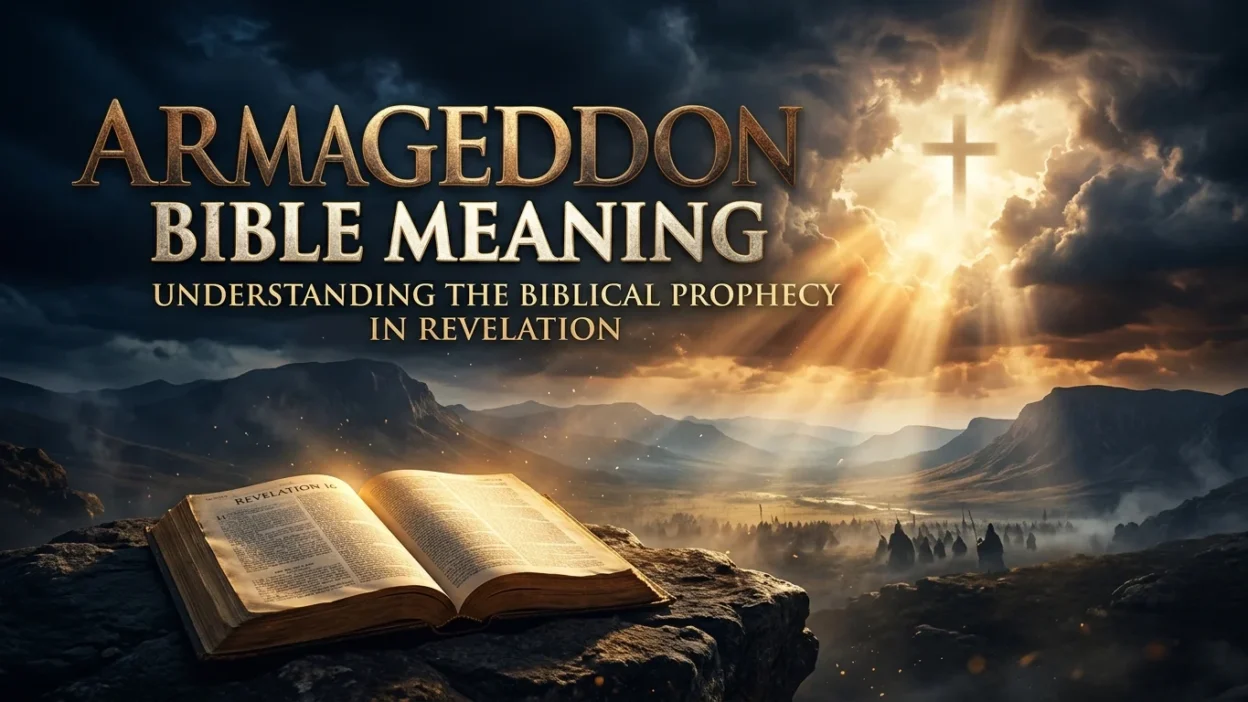
The Armageddon Bible meaning refers to the great final battle associated with God’s judgment and the defeat of evil. The word Armageddon appears in Revelation 16:16, where it describes the place in which the kings of the earth gather for battle against God. It is commonly connected with the end times, the return of Jesus Christ, and the final victory of God over Satan and evil.
Many people hear the word Armageddon in movies, news reports, and religious discussions. However, its biblical meaning is deeper than a simple worldwide disaster.
In the Bible, Armageddon represents a powerful moment in the story of God’s plan for humanity. Understanding its original context helps readers separate biblical teachings from popular beliefs and understand what Scripture actually says about the last days.
Quick Answer: What Is the Armageddon Bible Meaning?
The Armageddon Bible meaning is connected to the final conflict between the forces of evil and God’s authority. The word appears in Revelation 16:16 as the name of a place called Armageddon, where the kings of the earth gather for battle. It symbolizes God’s ultimate victory over evil and His final judgment.
Why Do People Confuse the Meaning of Armageddon?
People often confuse Armageddon because the word is used in different ways in religion, entertainment, and everyday language.
In popular culture, Armageddon usually means a massive disaster, worldwide destruction, or the end of civilization. Movies and television programs often use it to describe nuclear war, natural disasters, or an imaginary end-of-the-world event.
The Bible presents a more specific meaning. Armageddon is mentioned in the Book of Revelation and is connected with the gathering of earthly kings for the great battle associated with God’s judgment.
There are three common reasons for this confusion:
- Religious meaning: Armageddon is associated with the final conflict between God’s power and evil.
- Popular meaning: People use it to describe a catastrophic event or worldwide destruction.
- Prophetic meaning: Many Christians connect it with end-times prophecy and the return of Jesus Christ.
Understanding these differences makes the biblical meaning much easier to understand.
What Does the First Word Mean? Understanding “Arma”
The word Armageddon comes from the Greek form Harmagedōn (Ἁρμαγεδών), found in Revelation 16:16.
Its first part is commonly connected with the Hebrew word har, meaning “mountain.”
The word is generally understood as referring to the mountain or hill of Megiddo.
Megiddo was an important ancient location in the land of Israel. It was associated with several historical battles and had strategic importance because of its geographical position.
It is important to understand that the word is not simply a combination of two ordinary English words. Its background comes from ancient Hebrew and Greek language traditions.
What Does the Second Word Mean? Understanding “Megiddo”
Megiddo was an ancient city located in northern Israel, near the Jezreel Valley.
The area was strategically important because it connected major trade and military routes. Several significant battles took place in the surrounding region throughout biblical history.
Megiddo is mentioned in the Old Testament in connection with historical events, including the death of King Josiah.
2 Kings 23:29 describes how King Josiah was killed when he encountered Pharaoh Necho at Megiddo.
Because of its historical association with warfare, Megiddo became an important geographical reference when discussing biblical judgment and the final conflict.
The name Armageddon is commonly interpreted as “Mount Megiddo,” although the exact geographical identification and meaning have been discussed by biblical scholars.
Armageddon vs. Other Biblical End-Times Terms
Armageddon is related to several biblical ideas, but these terms do not all mean the same thing.
| Term | Meaning | Biblical Reference |
| Armageddon | Place where earthly kings gather for battle | Revelation 16:16 |
| Tribulation | Period of suffering and trouble | Matthew 24:21 |
| Second Coming | Return of Jesus Christ | Matthew 24:30 |
| Judgment Day | Time of God’s final judgment | Revelation 20:11–15 |
| Millennium | Thousand-year reign mentioned in Revelation | Revelation 20:1–6 |
| New Heaven and New Earth | God’s renewed creation | Revelation 21:1 |
These terms are connected through biblical discussions of the end times, but they describe different events or themes.
When Should You Use the Word Armageddon?
The word Armageddon can be used in religious, historical, and everyday conversations. Its meaning depends on the context.
1. In biblical discussions
Use Armageddon when discussing Revelation 16:16, biblical prophecy, or the final conflict between good and evil.
Example: Many Christians study Armageddon to understand the end-times prophecies in Revelation.
2. In religious teaching
The word can describe God’s ultimate victory over evil and His authority over the world.
Example: The preacher explained the biblical significance of Armageddon during the sermon.
3. In everyday English
People sometimes use Armageddon to describe a situation involving extreme destruction or chaos.
Example: The sudden storm created an Armageddon-like scene across the city.
4. In discussions about world events
The word may be used figuratively when people discuss the possibility of a catastrophic war or global disaster.
Example: Some commentators used the word Armageddon to describe the possible consequences of a major international conflict.
12 Examples of Armageddon in Sentences
Here are 12 simple examples showing how to use Armageddon naturally in different situations.
- The Bible mentions Armageddon in Revelation 16:16.
- Many Christians believe Armageddon is connected with the final battle between good and evil.
- The pastor explained the meaning of Armageddon during Sunday worship.
- Revelation describes the gathering of kings at a place called Armageddon.
- People often associate Armageddon with the end of the world.
- The word Armageddon has a special meaning in Christian prophecy.
- Bible students study Armageddon to understand the Book of Revelation.
- The movie showed a fictional Armageddon caused by a massive disaster.
- Some Christians have different interpretations of the events surrounding Armageddon.
- Armageddon reminds believers that evil does not have the final victory in God’s plan.
- The ancient city of Megiddo is important when studying the background of Armageddon.
- The teacher explained why the biblical meaning of Armageddon differs from its popular meaning.
Common Mistakes About Armageddon
Several misunderstandings can make it difficult to understand the biblical meaning of Armageddon.
Mistake 1: Thinking Armageddon means only the destruction of Earth.
The Bible connects Armageddon with a gathering for battle and divine judgment. It does not simply define the word as the destruction of the planet.
Mistake 2: Believing the word appears throughout the Bible.
Armageddon is specifically mentioned by name in Revelation 16:16.
Mistake 3: Assuming every Christian interprets it the same way.
Christian traditions have different understandings of how the events in Revelation should be interpreted.
Mistake 4: Confusing Armageddon with Judgment Day.
These concepts are related to biblical end-times teaching, but they are not interchangeable.
Mistake 5: Believing every modern disaster is Armageddon.
A war, earthquake, or natural disaster should not automatically be identified as the biblical Armageddon.
Memory Trick: How to Remember Armageddon
A simple way to remember Armageddon is:
Armageddon = Megiddo + Final Conflict + God’s Victory.
Think about three important ideas:
- Megiddo: The ancient geographical name connected with the word.
- Final conflict: The gathering of earthly powers described in Revelation.
- God’s victory: The larger biblical message that evil will not overcome God.
This simple memory trick can help you remember the word’s biblical meaning.
American vs. British English: Is Armageddon Different?
There is no major difference between American and British English when using the word Armageddon.
Both varieties use the same spelling, pronunciation, and general meaning.
| Feature | American English | British English |
| Spelling | Armageddon | Armageddon |
| General meaning | Great destruction or final conflict | Great destruction or final conflict |
| Biblical meaning | Final conflict associated with Revelation | Final conflict associated with Revelation |
| Usage | Religious and everyday conversations | Religious and everyday conversations |
The main difference is pronunciation and accent, not spelling or meaning.
Similar Words Related to Armageddon
Several words are connected with Armageddon because they describe destruction, conflict, judgment, or the end of an era.
- Apocalypse: A revelation or an event associated with worldwide destruction.
- Doomsday: A term commonly used for the final day or the end of the world.
- Tribulation: A period of great suffering or distress.
- Judgment: A decision or evaluation, especially God’s judgment in biblical teaching.
- Destruction: The act of damaging or completely ruining something.
- Conflict: A struggle or battle between opposing forces.
- Prophecy: A message or prediction connected with God’s revelation.
- Second Coming: The return of Jesus Christ according to Christian belief.
Although these words are related, they do not have exactly the same biblical meaning as Armageddon.
Final Verdict: What Does Armageddon Really Mean?
The true biblical meaning of Armageddon is connected with the gathering of earthly kings for the final conflict described in Revelation 16:16. Its name is commonly associated with ancient Megiddo in Israel.
Armageddon is more than a popular expression for worldwide destruction. It is an important part of biblical end-times teaching that points toward God’s judgment, authority, and ultimate victory over evil.
Frequently Asked Questions About Armageddon Bible Meaning
1. What does Armageddon mean in the Bible?
Armageddon refers to the place where the kings of the earth are gathered for battle in Revelation 16:16. It is associated with the final conflict between the forces opposing God and His authority.
2. Where is Armageddon mentioned in the Bible?
Armageddon is mentioned by name in Revelation 16:16. This verse explains that the kings of the earth are gathered together at a place called Armageddon.
3. Is Armageddon the end of the world?
Armageddon is commonly associated with end-times events, but Revelation 16:16 does not directly define it as the physical destruction of the entire planet. Christian interpretations differ about the exact nature and timing of this conflict.
4. What does Armageddon mean in Hebrew?
Armageddon comes from the Greek form Harmagedōn. It is commonly connected with the Hebrew elements har, meaning mountain, and Megiddo, an ancient location in Israel.
5. Is Armageddon a real place?
Megiddo is a real ancient archaeological site in northern Israel. The exact identification of the biblical Armageddon with a specific geographical location is debated, although Megiddo is widely recognized as the name’s geographical reference.
6. What happens during Armageddon according to Revelation?
Revelation 16 describes earthly kings being gathered for battle. Later passages, particularly Revelation 19, describe Christ’s victory over the opposing forces. Christians differ in how they understand the relationship and chronology of these passages.
7. What is the spiritual lesson of Armageddon?
One important spiritual lesson is that evil and rebellion do not have the final authority. Armageddon reminds believers of God’s power, justice, and ultimate victory.
8. Is Armageddon the same as the Second Coming of Jesus?
No. Armageddon and the Second Coming are related in many Christian interpretations of end-times prophecy, but they are not identical terms. The Second Coming refers to Christ’s return, while Armageddon refers to the gathering for battle described in Revelation 16:16.
Remember This: Key Facts About Armageddon
- Biblical reference: Revelation 16:16.
- Original form: Greek Harmagedōn.
- Geographical connection: Megiddo in ancient Israel.
- Main theme: Final conflict and God’s judgment.
- Related teaching: End-times prophecy.
- Important message: Evil will not ultimately defeat God.
- Common misunderstanding: Armageddon does not simply mean any worldwide disaster.
The most important thing to remember is that the Bible presents Armageddon within the larger message of God’s authority and victory.
Conclusion
The Armageddon Bible meaning is an important subject for anyone studying biblical prophecy and the Book of Revelation. It refers to the place where the kings of the earth gather for battle, as described in Revelation 16:16. Its historical connection with Megiddo helps explain the background of this powerful biblical term. Although people often use Armageddon to describe worldwide destruction, its biblical meaning is more closely connected with divine judgment and the final conflict between good and evil.
For Christians, the message of Armageddon is also a reminder of God’s power, justice, and ultimate victory. While different Christian traditions interpret the details of end-times prophecy differently, the central message remains clear: evil does not have the final word, and God’s authority stands above all earthly powers.