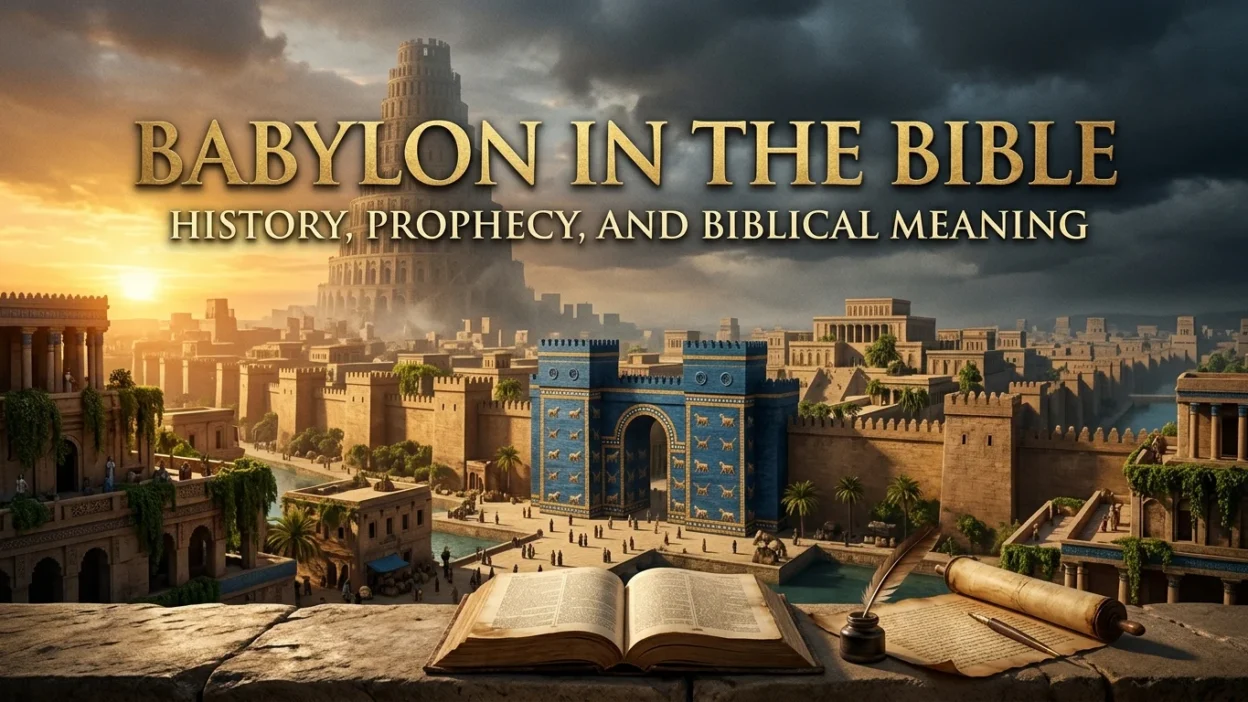
Babylon in the Bible is a powerful symbol of pride, rebellion, human power, and opposition to God. It was an ancient city located in Mesopotamia, near present-day Iraq. In Scripture, Babylon represents both a real historical kingdom and a spiritual picture of people and systems that turn away from God.
The Babylon in the Bible meaning becomes clearer when we examine its history, its role in biblical events, and its spiritual symbolism. From the Tower of Babel in Genesis to the fall of Babylon in Revelation, this city appears throughout the Bible as an important example of human ambition, judgment, and God’s authority.
Babylon also played a major role in the history of Israel and Judah. The Babylonian Empire conquered Jerusalem, destroyed Solomon’s Temple, and took many Jewish people into exile.
However, Babylon’s story is not only about destruction. It also includes lessons about faith, patience, hope, and God’s promises. Understanding Babylon helps readers better understand several important biblical teachings.
Quick Answer: What Does Babylon Mean in the Bible?
Babylon in the Bible refers to an ancient city and empire that often symbolizes pride, idolatry, rebellion against God, and worldly power. It was responsible for Jerusalem’s destruction and the Jewish exile. In Revelation, Babylon represents a corrupt system opposed to God. Its ultimate fall demonstrates that God’s authority is greater than every earthly kingdom.
Why Do People Confuse Babylon in the Bible?
People sometimes confuse Babylon because the Bible uses the name in different historical and spiritual contexts.
In the Old Testament, Babylon was a real city and the center of a powerful empire. It became especially important when King Nebuchadnezzar conquered Jerusalem and took Jewish people into captivity.
In the New Testament, particularly in Revelation, Babylon carries a deeper symbolic meaning. It represents corruption, spiritual rebellion, materialism, and opposition to God’s kingdom.
Another reason for confusion is the connection between Babylon and Babel. Genesis 11 describes the Tower of Babel, where people tried to build a city and a tower reaching the heavens. The names are closely related, and both stories highlight human pride and independence from God.
Understanding these differences makes the biblical message easier to follow.
First Word: What Is the Meaning of Babylon?
Babylon is the biblical name of an ancient Mesopotamian city. Its historical background is connected with the Akkadian name Bābili, commonly understood as “Gate of God.”
However, the biblical meaning of Babylon goes beyond its name’s historical origin.
Throughout Scripture, Babylon becomes associated with several important ideas:
- Pride: People place their achievements above God’s authority.
- Rebellion: Human beings reject God’s instructions.
- Idolatry: People worship false gods instead of the Lord.
- Worldly power: Earthly kingdoms become symbols of human ambition.
- Judgment: Babylon demonstrates that powerful nations cannot escape God’s judgment.
- Captivity: It represents the suffering and displacement experienced by God’s people.
Babylon’s meaning depends on the passage in which it appears. Sometimes it refers to the actual city, while other times it represents a larger spiritual reality.
Second Word: What Does Babylon Represent Spiritually?
Spiritually, Babylon represents a society or system that values human power, wealth, pride, and false worship above God.
Its symbolism becomes especially important in the book of Revelation.
Revelation 17 describes Babylon as a corrupt and powerful figure associated with spiritual unfaithfulness and worldly influence. Revelation 18 announces its downfall and warns people against participating in its sins.
The spiritual lessons of Babylon include:
- Pride can lead people away from God.
- Wealth and success cannot replace spiritual truth.
- Idolatry damages the relationship between people and God.
- Powerful governments are not greater than God’s authority.
- Evil systems may appear successful but cannot last forever.
- Faithfulness to God matters even during difficult times.
For Christians, Babylon serves as a warning against allowing worldly values to control their beliefs and actions.
Babylon vs. Babel: What Is the Difference?
Babylon and Babel are closely connected names in the biblical story, but they appear in different contexts.
| Feature | Babel | Babylon |
| Main Bible reference | Genesis 11:1–9 | Genesis 10:10; Daniel 1; Revelation 17–18 |
| Main meaning | Human pride and confusion | Worldly power and rebellion |
| Historical connection | Early city and tower | Ancient Mesopotamian city and empire |
| Main biblical event | Tower of Babel | Babylonian conquest and exile |
| Spiritual lesson | Do not place human ambition above God | Do not follow corrupt worldly systems |
| Famous ruler | Nimrod is associated with Babel’s early setting | Nebuchadnezzar II |
| Main outcome | People are scattered | Babylon faces divine judgment |
Important: Babel and Babylon are closely related in biblical language and tradition. However, they should not be treated as identical in every passage.
When Should You Understand Babylon as a City or a Symbol?
The meaning of Babylon depends on the biblical passage.
1. Babylon as a Historical City
When reading Genesis, Kings, Chronicles, Jeremiah, Ezekiel, or Daniel, Babylon often refers to the actual ancient city or its empire.
For example, Daniel 1:1–2 describes Nebuchadnezzar’s attack on Jerusalem and the removal of articles from God’s temple.
2. Babylon as a Symbol of Rebellion
In passages discussing pride, idolatry, and opposition to God, Babylon can represent a broader pattern of human rebellion.
The Tower of Babel is an early example of this pattern.
3. Babylon as a Symbol in Revelation
In Revelation 17–18, Babylon represents a corrupt power associated with spiritual unfaithfulness, luxury, exploitation, and opposition to God.
Christians differ on the precise historical and future identification of Revelation’s Babylon, but its central message is clear: corrupt power will not overcome God’s kingdom.
10 Important Examples of Babylon in the Bible
The following biblical examples explain how Babylon develops from a historical location into an important spiritual symbol.
1. Babylon First Appears in Genesis
Genesis 10:10 mentions Babel as part of Nimrod’s kingdom.
This passage introduces the city in the early history of humanity and connects it with the beginning of powerful kingdoms.
2. The Tower of Babel
Bible reference: Genesis 11:1–9
People gathered together to build a city and a tower reaching toward heaven.
Their goal was to make a name for themselves and avoid being scattered across the earth.
God confused their language and scattered them.
Spiritual lesson: Human pride and ambition cannot replace obedience to God.
3. Babylon Becomes a Powerful Empire
Babylon eventually became one of the most influential kingdoms of the ancient Near East.
Under its powerful rulers, it expanded its territory and influence.
Spiritual lesson: Earthly power may grow, but it remains under God’s authority.
4. King Nebuchadnezzar Conquers Jerusalem
Bible reference: 2 Kings 24–25
King Nebuchadnezzar II conquered Jerusalem during the Babylonian campaigns against Judah.
The city suffered destruction, and many people were taken into exile.
Spiritual lesson: The story reminds readers that national rebellion and injustice have serious consequences.
5. Daniel Is Taken to Babylon
Bible reference: Daniel 1:1–7
Daniel and other young men from Judah were brought to Babylon.
They were selected for training in the Babylonian royal court.
Although Daniel lived in a foreign culture, he remained committed to his faith.
Spiritual lesson: Believers can remain faithful to God even when surrounded by different beliefs and values.
6. Shadrach, Meshach, and Abednego Refuse Idolatry
Bible reference: Daniel 3
Nebuchadnezzar created a golden image and commanded people to worship it.
Shadrach, Meshach, and Abednego refused to bow down.
They were thrown into a fiery furnace, but God protected them.
Spiritual lesson: Faithfulness to God is more important than pleasing powerful people.
7. Nebuchadnezzar Learns Humility
Bible reference: Daniel 4
Nebuchadnezzar became proud of his achievements and kingdom.
God humbled him until he recognized that the Most High rules over human kingdoms.
Spiritual lesson: Pride can bring a person down, while humility recognizes God’s authority.
8. The Writing on the Wall
Bible reference: Daniel 5
During King Belshazzar’s feast, a mysterious hand wrote a message on the palace wall.
Daniel interpreted the words as a judgment against the king.
That night, Babylon fell to the Medes and Persians.
Spiritual lesson: No ruler or kingdom can escape God’s judgment.
9. Babylon’s Fall Is Prophesied
Bible reference: Isaiah 13 and Jeremiah 50–51
The prophets announced judgment against Babylon because of its pride, violence, and oppression.
These prophecies demonstrate that God holds nations accountable for their actions.
Spiritual lesson: Injustice and arrogance do not go unnoticed by God.
10. Babylon Falls in Revelation
Bible reference: Revelation 17–18
Revelation describes Babylon as a powerful symbol of corruption, spiritual unfaithfulness, and worldly influence.
Its destruction demonstrates the final defeat of evil.
Spiritual lesson: God’s kingdom will ultimately overcome every system that opposes Him.
Common Mistakes About Babylon in the Bible
Readers sometimes misunderstand Babylon because its historical and symbolic meanings overlap.
Here are common mistakes to avoid:
Mistake 1: Thinking Babylon is only a spiritual symbol.
Babylon was a real ancient city and the center of an important empire. Its historical role is essential to understanding Scripture.
Mistake 2: Believing Babylon and Babel mean exactly the same thing.
The names are connected, but their biblical contexts are different.
Mistake 3: Thinking Babylon represents only evil people.
In Revelation, Babylon represents a broader corrupt system rather than simply one individual or group.
Mistake 4: Assuming every reference to Babylon describes the same event.
Genesis, Daniel, and Revelation discuss different periods and situations.
Mistake 5: Thinking Babylon’s power lasted forever.
The Babylonian Empire eventually fell, showing that earthly kingdoms are temporary.
Mistake 6: Forgetting the lessons of faith and hope.
The Babylonian exile was painful, but the Bible also describes God’s faithfulness and the eventual return of Jewish exiles.
Memory Trick: How to Remember Babylon’s Biblical Meaning
A simple way to remember Babylon is:
Babylon = Pride + Power + Rebellion + Judgment
Think of these four words whenever you read about Babylon in Scripture.
- Pride reminds you of the Tower of Babel.
- Power reminds you of Nebuchadnezzar.
- Rebellion reminds you of idolatry and opposition to God.
- Judgment reminds you of Babylon’s eventual fall.
This simple memory trick helps connect Babylon’s historical story with its spiritual meaning.
American vs. British English: Is There a Difference?
The word Babylon is spelled the same way in American and British English.
| Feature | American English | British English |
| Spelling | Babylon | Babylon |
| Pronunciation | Usually BAH-buh-lon | Usually BAB-uh-lon |
| Meaning | Ancient city and biblical symbol | Ancient city and biblical symbol |
| Biblical usage | Same | Same |
There is no meaningful difference in the biblical meaning of Babylon between American and British English.
The spelling and historical meaning remain the same in both varieties.
Similar Words and Related Biblical Terms
Several biblical names and concepts are connected with Babylon.
1. Babel
Babel is associated with the Tower of Babel in Genesis 11. It represents human pride and the confusion of languages.
2. Babylonian Exile
This refers to the period when many people from Judah were taken captive to Babylon following the Babylonian conquest.
3. Nebuchadnezzar
Nebuchadnezzar II was the Babylonian king responsible for Jerusalem’s destruction in 586 BC.
4. Idolatry
Idolatry means worshiping idols or treating something other than God as the highest object of devotion.
5. Jerusalem
Jerusalem was the capital of Judah and the location of Solomon’s Temple before its destruction by the Babylonians.
6. Zion
Zion is a biblical term associated with Jerusalem and God’s dwelling place. It often represents God’s people and His promises.
7. Chaldeans
The Chaldeans were an ancient people associated with the Neo-Babylonian Empire.
8. Exile
Exile means being forced to live away from one’s homeland. The Babylonian exile was one of the most important events in Jewish history.
Final Verdict: What Is the True Meaning of Babylon in the Bible?
Babylon in the Bible has both historical and spiritual meanings.
Historically, it was an influential Mesopotamian city and the center of an empire that conquered Judah and destroyed Jerusalem.
Spiritually, Babylon represents pride, idolatry, rebellion, corruption, and worldly power that stands against God’s authority.
Its story begins with the early account of Babel, continues through the Babylonian exile, and reaches its symbolic climax in Revelation 17–18.
The most important lesson is that human power is temporary, pride leads to destruction, and God remains sovereign over every kingdom.
(FAQs): About Babylon in the Bible
1. What does Babylon mean spiritually in the Bible?
Spiritually, Babylon represents pride, rebellion, idolatry, corruption, and worldly systems that oppose God. It reminds Christians not to place wealth, power, or human ambition above their relationship with God.
2. Why is Babylon important in the Bible?
Babylon is important because it played a major role in Israel’s history. It conquered Jerusalem, destroyed Solomon’s Temple, and took many Jewish people into exile. It also became an important symbol of rebellion and judgment in Revelation.
3. What does Babylon symbolize in Revelation?
In Revelation 17–18, Babylon symbolizes a corrupt and powerful system associated with idolatry, luxury, exploitation, and opposition to God. Its fall represents the defeat of evil and the victory of God’s kingdom.
4. Is Babylon the same as Babel in the Bible?
Babylon and Babel are closely connected names, but they appear in different biblical contexts. Babel is associated with the Tower of Babel in Genesis 11, while Babylon becomes the name of a major city and empire in biblical history.
5. Who destroyed Babylon in the Bible?
The Neo-Babylonian Empire fell to the forces of the Medes and Persians under Cyrus the Great in 539 BC. Daniel 5 describes the fall of Babylon during the reign of Belshazzar.
6. Why did God punish Babylon?
Biblical prophecies associate Babylon’s judgment with pride, violence, idolatry, oppression, and its treatment of God’s people. Isaiah 13 and Jeremiah 50–51 describe judgment against the city and its empire.
7. What can Christians learn from Babylon?
Christians can learn to avoid pride, remain faithful to God, reject idolatry, and avoid trusting worldly power. Babylon also reminds believers that no earthly kingdom lasts forever and that God’s authority is supreme.
Remember This
Babylon was more than an ancient city in the Bible. It became a powerful example of human pride, worldly influence, rebellion, and divine judgment.
Remember these key points:
- Babylon was an ancient city in Mesopotamia.
- It became the center of the Babylonian Empire.
- Nebuchadnezzar conquered Jerusalem and took Jewish people into exile.
- Daniel and his friends demonstrated faithfulness while living in Babylon.
- Revelation uses Babylon as a symbol of corruption and opposition to God.
- Babylon’s fall reminds readers that God’s kingdom is greater than earthly power.
Conclusion
The meaning of Babylon in the Bible combines history, prophecy, and spiritual lessons. It was a real ancient city that became one of the most powerful empires in the biblical world. Its conquest of Jerusalem and the Babylonian exile deeply affected the history of God’s people. Through the stories of Daniel, Nebuchadnezzar, and Belshazzar, Scripture teaches important lessons about humility, faith, and God’s authority.
Babylon also carries a lasting spiritual message in Revelation. It represents the pride, corruption, and worldly influence that oppose God’s ways. Its eventual fall reminds believers that wealth, power, and human greatness are temporary. The story of Babylon encourages Christians to remain faithful, trust God, and choose His truth over worldly influence.