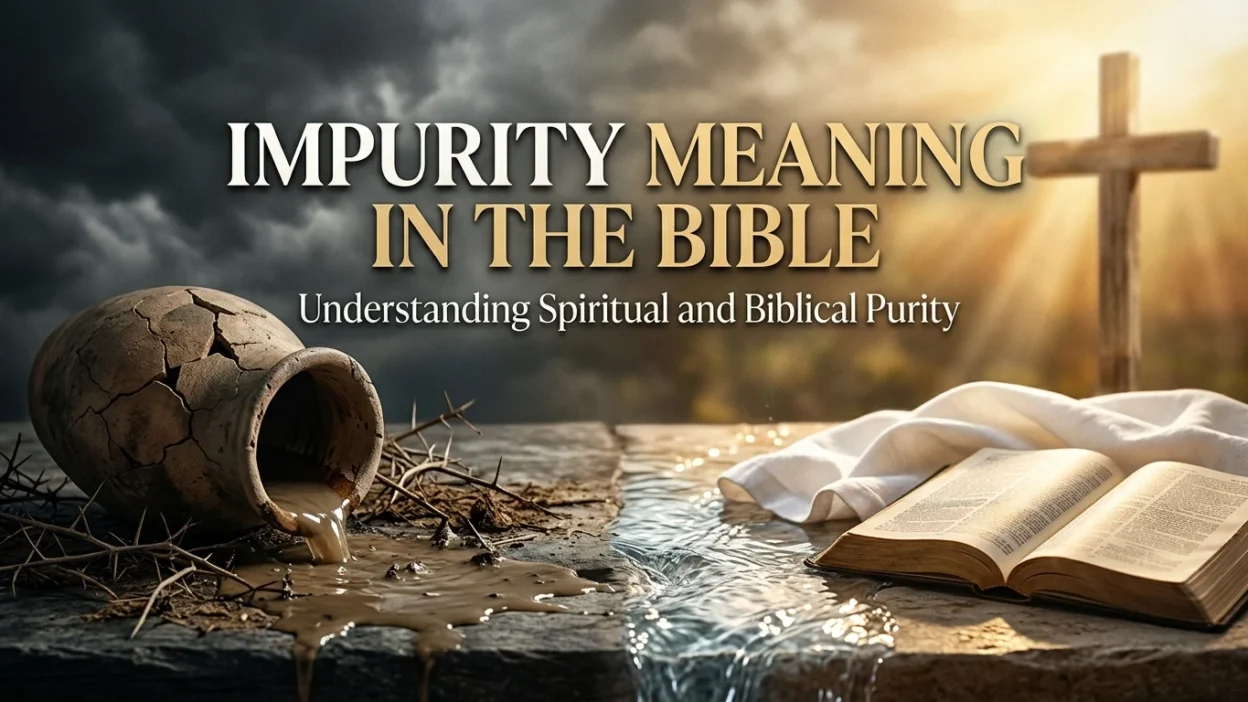
The meaning of impurity in the Bible refers to a condition of being unclean, either physically, ceremonially, or spiritually. In Scripture, impurity can describe anything that separates a person from God’s holiness, including sinful thoughts, immoral actions, idolatry, and certain conditions that made people ceremonially unclean. The Bible teaches that God desires His people to live pure lives and remain devoted to Him.
However, biblical impurity does not always mean that someone has committed a sin. In the Old Testament, certain natural bodily conditions, contact with dead bodies, and other situations could make a person ceremonially unclean without making them morally guilty.
In the New Testament, Jesus places greater emphasis on the condition of the human heart, teaching that evil thoughts and sinful actions come from within. Understanding this difference helps readers discover what impurity truly means in biblical teaching.
Quick Answer: What Does Impurity Mean in the Bible?
Impurity in the Bible means being unclean physically, ceremonially, or spiritually. It can refer to ritual uncleanness under Old Testament laws or moral corruption caused by sin. Scripture teaches that God calls His people to reject sinful behavior, seek forgiveness, and maintain purity in their hearts and lives.
Why Do People Confuse Impurity in the Bible?
People often confuse biblical impurity because the Bible uses the idea of uncleanness in different ways.
In the Old Testament, impurity frequently describes ceremonial conditions that affected worship and participation in religious activities. These conditions were not always the result of wrongdoing.
In the New Testament, impurity is often connected with sinful behavior, unhealthy desires, and the condition of the heart.
The main difference is that ceremonial impurity concerns religious cleanliness under the law, while moral impurity concerns a person’s actions, thoughts, and relationship with God.
First Word: Impurity
The word impurity means a state of being unclean, contaminated, or lacking purity.
It comes from the word pure, which means clean, genuine, or free from contamination. The prefix im- changes the meaning to its opposite.
In biblical language, impurity can describe:
- Ceremonial uncleanness.
- Sinful thoughts and desires.
- Sexual immorality.
- Idolatry and spiritual unfaithfulness.
- Actions that go against God’s commandments.
- A heart that needs spiritual cleansing.
For example, when the Bible speaks about sexual impurity, it refers to behavior that goes against God’s instructions for holiness and moral living.
Second Word: Meaning in the Bible
The biblical meaning of impurity depends on the passage and its context.
In the Old Testament, the Hebrew concept of tumah is associated with ritual uncleanness. Certain situations could make someone ceremonially unclean and temporarily restrict their participation in worship.
In the New Testament, the Greek word akatharsia is commonly translated as impurity or uncleanness. It often describes moral corruption, sinful desires, and behavior that does not reflect God’s holiness.
Together, these biblical ideas show that purity involves more than outward cleanliness. It also involves the heart, mind, behavior, and relationship with God.
Impurity vs. Purity: What Is the Difference?
Impurity and purity represent two contrasting conditions in biblical teaching.
| Impurity | Purity |
| A condition of being unclean | A condition of being clean |
| Can involve sinful thoughts and actions | Involves righteous thoughts and actions |
| Can describe ceremonial uncleanness | Can describe ceremonial or spiritual cleanness |
| Associated with moral corruption | Associated with holiness and goodness |
| Can affect fellowship and worship | Reflects devotion to God |
| Requires cleansing or restoration | Reflects a condition God desires |
The Bible encourages believers to turn away from impurity and pursue purity through faith, obedience, and a transformed heart.
When to Use Each Meaning of Impurity?
The word impurity has different meanings depending on the biblical situation.
1. Ceremonial impurity
Use this meaning when discussing Old Testament laws about ritual cleanliness.
For example, Leviticus 15 describes certain bodily conditions that made a person ceremonially unclean for a period of time.
2. Moral impurity
Use this meaning when discussing sinful actions, dishonesty, immoral behavior, or evil desires.
For example, Galatians 5:19 includes impurity among the works of the flesh.
3. Spiritual impurity
Use this meaning when discussing anything that damages a person’s devotion to God, such as idolatry or a heart controlled by sinful desires.
4. Inner impurity
Use this meaning when discussing thoughts, intentions, and desires that come from the human heart.
In Mark 7:20–23, Jesus teaches that evil things coming from within a person are what make that person spiritually unclean.
12 Biblical Examples of Impurity
The Bible provides several examples that help explain the meaning of impurity. These examples show how uncleanness can relate to ceremonial laws, moral behavior, and spiritual life.
1. Sexual Immorality
Sexual immorality is one of the clearest examples of moral impurity in Scripture.
Galatians 5:19 includes sexual immorality and impurity among the works of the flesh.
This teaches that God wants people to respect His instructions about sexual behavior and relationships.
2. Evil Thoughts
In Mark 7:21–23, Jesus explains that evil thoughts and actions come from within the human heart.
These include sinful intentions, pride, greed, and other forms of wrongdoing.
The lesson is that spiritual purity begins inside a person.
3. Idolatry
Idolatry means worshipping something other than God.
In Ezekiel 36:25, God promises to cleanse His people from their impurities and idols.
This example connects spiritual cleansing with turning away from false worship.
4. Contact With a Dead Body
Numbers 19:11 explains that a person who touched a dead body became ceremonially unclean for seven days.
This was a ritual condition under the Old Testament law, not automatically a personal sin.
5. Certain Skin Conditions
Leviticus 13 describes laws concerning skin diseases and conditions that required examination by a priest.
Some conditions resulted in ceremonial uncleanness.
These instructions were part of Israel’s religious cleanliness laws.
6. Childbirth
Leviticus 12 describes the purification requirements following childbirth.
This ceremonial impurity did not mean that giving birth was sinful. It was part of the ritual system established for ancient Israel.
7. Certain Bodily Discharges
Leviticus 15 discusses bodily discharges and the ceremonial cleansing requirements connected with them.
These laws demonstrate that biblical impurity could involve natural physical conditions rather than moral wrongdoing.
8. Greed and Evil Desires
Greed reflects an unhealthy desire for wealth, possessions, or power.
In Colossians 3:5, Paul connects greed with idolatry and instructs believers to put away sinful earthly desires.
This shows that impurity can begin with attitudes and desires inside the heart.
9. Dishonest Behavior
Dishonesty goes against the biblical principles of truth and righteousness.
Ephesians 4:25 encourages believers to put away falsehood and speak truthfully.
A dishonest life does not reflect the purity God desires.
10. Unclean Lips
In Isaiah 6:5, Isaiah describes himself as a man of unclean lips while recognizing God’s holiness.
His words express his awareness of human sinfulness in the presence of a holy God.
This example highlights the need for spiritual cleansing.
11. Impurity Through Sinful Living
Second Corinthians 7:1 encourages believers to cleanse themselves from everything that defiles the body and spirit.
The verse connects spiritual growth with rejecting sinful behavior and pursuing holiness.
12. Cleansing Through God’s Word
Psalm 119:9 asks how a young person can keep their way pure. The answer is by living according to God’s Word.
This example teaches that Scripture provides guidance for making good decisions and developing a pure life.
Common Mistakes About Biblical Impurity
Readers sometimes misunderstand impurity because they apply one biblical meaning to every passage.
Here are some common mistakes to avoid:
- Thinking all impurity is sin: Some Old Testament ceremonial conditions were natural and did not involve personal wrongdoing.
- Confusing physical and spiritual uncleanness: Ritual cleanliness and moral purity are related concepts but are not identical.
- Believing impurity cannot be forgiven: The Bible repeatedly teaches that God offers forgiveness and cleansing to those who repent.
- Ignoring the heart: Jesus teaches that sinful thoughts and intentions matter, not just outward behavior.
- Assuming every use of unclean means evil: The context determines whether a passage discusses ritual, physical, or moral uncleanness.
- Forgetting God’s mercy: Biblical teachings about impurity also point toward forgiveness, restoration, and spiritual renewal.
Understanding these differences makes biblical passages easier to interpret correctly.
Memory Trick: How to Remember Impurity in the Bible
A simple way to remember the meaning of impurity is:
Impurity = Unclean condition
Think of three important categories:
- Body: Ceremonial uncleanness under Old Testament laws.
- Behavior: Sinful actions and immoral choices.
- Heart: Evil thoughts, desires, and spiritual corruption.
Remember this simple sentence:
“Impurity can affect the body, behavior, or heart, but God calls His people to pursue holiness and purity.”
This memory trick can help you understand different biblical passages without confusing their meanings.
American vs. British English: Is There a Difference?
There is no spelling difference between American and British English for the word impurity.
Both varieties use the same spelling and meaning.
| Feature | American English | British English |
| Spelling | Impurity | Impurity |
| Plural | Impurities | Impurities |
| Meaning | State of being unclean | State of being unclean |
| Pronunciation | Similar | Similar |
| Biblical usage | Same meaning | Same meaning |
For example:
- American English: Sinful behavior can lead to spiritual impurity.
- British English: Sinful behaviour can lead to spiritual impurity.
The only difference in these examples is the spelling of behavior and behaviour, not impurity.
Similar Words Related to Impurity
Several biblical words are closely related to impurity. However, they do not always have exactly the same meaning.
1. Uncleanness: A condition of being physically, ceremonially, or morally unclean.
2. Sin: An action, thought, or attitude that goes against God’s will.
3. Defilement: The act or condition of becoming spiritually or morally unclean.
4. Corruption: A condition of moral wrongdoing or spiritual decay.
5. Immorality: Behavior that goes against accepted moral principles and biblical teachings.
6. Wickedness: Deliberate evil behavior or opposition to righteousness.
7. Pollution: Something that contaminates or makes something unclean.
8. Purification: The process of becoming clean or being cleansed.
9. Holiness: A condition of being set apart for God and reflecting His character.
10. Righteousness: Living according to God’s standards of goodness and justice.
These related words help explain the wider biblical teaching about purity and holiness.
Final Verdict: What Does Biblical Impurity Really Teach?
The meaning of impurity in the Bible goes beyond ordinary physical cleanliness. It includes ceremonial uncleanness, sinful behavior, immoral desires, and spiritual corruption.
The Old Testament explains how ceremonial impurity affected the religious life of ancient Israel, while the New Testament places strong emphasis on inner purity and the condition of the heart.
The central lesson is that God desires people to turn away from sin, seek forgiveness, and live according to His Word. Impurity is not the end of a person’s spiritual journey because the Bible also offers hope through God’s mercy, forgiveness, and cleansing.
(FAQs):
1. What does impurity mean spiritually in the Bible?
Spiritually, impurity means having thoughts, desires, attitudes, or behaviors that go against God’s holiness. It can include greed, pride, sexual immorality, dishonesty, and idolatry. The Bible encourages people to seek forgiveness and develop a pure heart through faith and obedience.
2. Is impurity the same as sin in the Bible?
No, impurity and sin are not always the same. Moral impurity can involve sin, but ceremonial impurity under Old Testament law could result from natural conditions such as childbirth or contact with a dead body. The context determines the intended meaning.
3. What does God say about impurity?
God calls His people to avoid sinful behavior and pursue holiness. In 1 Thessalonians 4:7, Paul explains that God calls believers to holiness rather than impurity. This teaches the importance of living a life that honors God.
4. What is an example of impurity in the Bible?
Sexual immorality is one example of moral impurity. Galatians 5:19 includes impurity among the works of the flesh. Another example is ceremonial uncleanness through contact with a dead body, as described in Numbers 19:11.
5. How can a person become spiritually clean according to the Bible?
A person can seek spiritual cleansing through repentance, faith, and God’s forgiveness. First John 1:9 teaches that God is faithful and just to forgive sins and cleanse people from unrighteousness when they confess their sins.
6. What is the difference between clean and unclean in the Bible?
Clean and unclean can describe ceremonial conditions under Old Testament law. They can also describe spiritual and moral conditions. In a spiritual sense, clean represents purity and righteousness, while unclean can represent sin or moral corruption.
7. What does impurity mean in Galatians 5:19?
In Galatians 5:19, impurity refers to sinful behavior and moral corruption. Paul lists it among the works of the flesh, showing that believers should reject sinful desires and follow a life guided by the Holy Spirit.
8. Does God forgive impurity?
Yes. The Bible teaches that God offers forgiveness and spiritual cleansing to those who sincerely repent and turn to Him. First John 1:9 provides reassurance that God forgives confessed sins and cleanses people from unrighteousness.
Remember This
The most important things to remember about impurity in the Bible are:
- Impurity means being unclean physically, ceremonially, or spiritually.
- Not every ceremonial impurity was caused by sin.
- Moral impurity includes sinful thoughts, desires, and actions.
- Jesus teaches that the condition of the heart matters.
- God calls His people to holiness and righteousness.
- Forgiveness and spiritual cleansing are available through God’s mercy.
Key Bible Verse: First John 1:9 reminds believers that God forgives confessed sins and cleanses them from unrighteousness.
Conclusion
The biblical meaning of impurity teaches us that cleanliness is not only about the outside but also about the condition of the heart. Throughout Scripture, impurity can describe ceremonial uncleanness, sinful behavior, and spiritual corruption. Understanding these different meanings helps readers interpret the Bible more accurately and recognize why God calls His people to live holy lives.
The good news is that impurity does not have to define a person’s future. God’s Word offers forgiveness, cleansing, and a fresh beginning to those who turn to Him. By following biblical teachings, avoiding sinful choices, and developing a sincere heart, believers can grow spiritually and build a stronger relationship with God.