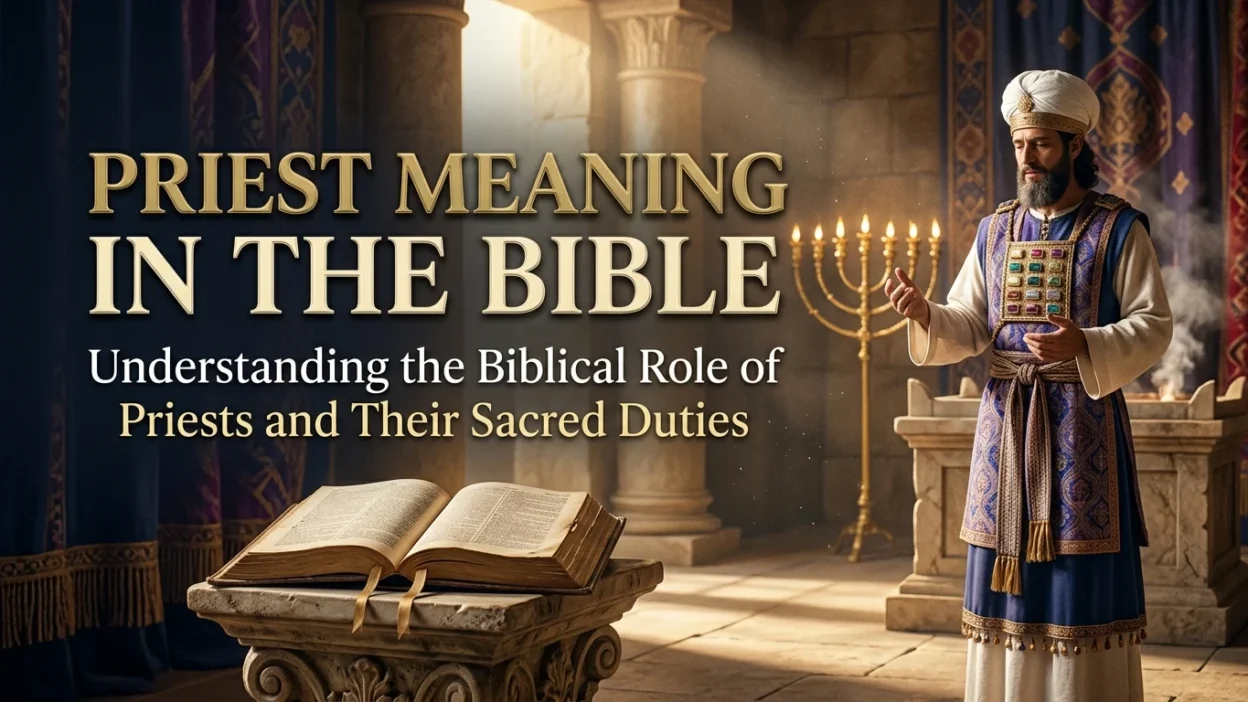
The priest meaning in the Bible refers to a person appointed or chosen to serve God, perform sacred duties, offer sacrifices, and help people worship Him. In the Old Testament, priests played an important role in Israel’s religious life.
They served in the tabernacle and later in the temple, taught God’s laws, offered sacrifices, and helped people understand their relationship with God. The priesthood was especially connected with Aaron and his descendants, whom God appointed for this special responsibility.
In the New Testament, the meaning of a priest becomes even more significant through Jesus Christ. Jesus is described as the great High Priest who provides the perfect sacrifice for sin.
The Bible also teaches that believers in Christ are part of a royal priesthood, meaning they can approach God and serve Him through faith. Understanding this biblical role helps readers discover the importance of worship, holiness, sacrifice, and spiritual service.
Quick Answer: What Does Priest Mean in the Bible?
A priest in the Bible is a person who serves God and performs religious duties on behalf of the people. Old Testament priests offered sacrifices, taught God’s commandments, and cared for worship in the tabernacle and temple. In the New Testament, Jesus is the ultimate High Priest, and believers are called a royal priesthood.
Why Do People Confuse the Meaning of Priest?
People sometimes confuse the biblical meaning of a priest because the role changes between the Old and New Testaments.
In the Old Testament, priests were specially appointed to perform religious responsibilities. They came from the crew of Levi, particularly from the family of Aaron.
In the New Testament, Jesus becomes the perfect High Priest, and believers receive a new spiritual identity through Him.
Another reason for confusion is that the Bible uses several related terms:
- Priest: A person who performs sacred duties and serves God.
- High Priest: The chief priest who held the highest religious position in Israel.
- Levite: A member of the crew of Levi who served in religious responsibilities.
- Royal Priesthood: A description of believers who belong to God and are called to serve Him.
Although these terms are connected, they do not have exactly the same meaning.
First Word: What Does Priest Mean?
The word priest refers to someone who serves God through religious worship and sacred responsibilities.
In the Bible, priests were responsible for helping the Israelites maintain their relationship with God. They offered sacrifices, performed ceremonies, taught God’s instructions, and helped maintain the holiness of the sanctuary.
The Old Testament priesthood was established through God’s instructions to Moses.
Exodus 28:1 (KJV) says:
“And take thou unto thee Aaron thy brother, and his sons with him, from among the children of Israel, that he may minister unto me in the priest’s office.”
This verse shows that Aaron and his sons were chosen for the priestly office.
Main Responsibilities of Biblical Priests
Biblical priests had several important responsibilities:
- Offering sacrifices to God.
- Teaching God’s commandments.
- Helping people understand religious laws.
- Performing sacred duties in the tabernacle and temple.
- Praying and making intercession as part of their religious service.
- Helping maintain the holiness of worship.
For example, when Israelites brought offerings to God, priests performed the required religious ceremonies according to God’s instructions.
Second Word: What Does Priest Mean Spiritually?
The spiritual meaning of a priest is connected with service, holiness, worship, and a close relationship with God.
In the Old Testament, priests served as religious representatives within Israel’s covenant worship system. Their responsibilities reminded the people that approaching a holy God required reverence and obedience.
In the New Testament, Jesus Christ fulfills the ultimate priestly role.
Hebrews 4:14 (KJV) says:
“Seeing then that we have a great high priest, that is passed into the heavens, Jesus the Son of God, let us hold fast our profession.”
This verse identifies Jesus as the great High Priest.
Through His death and resurrection, Jesus provides the way for people to approach God through faith.
The Bible also teaches that Christians have a spiritual calling to serve God.
1 Peter 2:9 (KJV) describes believers as:
“But ye are a chosen generation, a royal priesthood, an holy nation, a peculiar people.”
This means believers belong to God and are called to declare His goodness through their lives.
Priest vs. High Priest vs. Levite: What Is the Difference?
These three biblical terms are related, but each describes a different role or position.
| Term | Biblical Meaning | Main Responsibility |
| Priest | A person appointed for sacred religious duties | Offering sacrifices and serving in worship |
| High Priest | The chief priest of Israel | Leading major priestly responsibilities and entering the Most Holy Place on the Day of Atonement |
| Levite | A member of the cohort of Levi | Assisting with tabernacle and temple service |
| Royal Priesthood | Believers described as God’s spiritual people | Declaring God’s goodness and serving Him |
Important distinction: All priests in Israel belonged to the crew of Levi, but not every Levite was an Aaronic priest. The priestly office was specifically associated with Aaron and his descendants.
When Should You Use the Word Priest?
Use the word priest when discussing someone who has a religious role involving worship, sacred ceremonies, or spiritual service.
In biblical writing, the word is especially useful when explaining Old Testament worship, the priesthood of Aaron, or Jesus Christ’s role as High Priest.
Use it in these situations:
- When describing Aaron and his descendants.
- When explaining sacrifices in the Old Testament.
- When discussing the temple or tabernacle.
- When studying Jesus as the great High Priest.
- When explaining the royal priesthood in 1 Peter 2:9.
- When discussing religious leadership and spiritual responsibilities.
For example:
“The priest offered a sacrifice according to God’s instructions.”
This sentence correctly describes an Old Testament religious responsibility.
12 Biblical Examples of the Word Priest
The Bible contains many references to priests and their responsibilities. These examples help explain the meaning of the word in different situations.
1. Aaron as Israel’s First High Priest
Exodus 28:1
Aaron and his sons were appointed to serve God in the priestly office.
2. Priests Offering Sacrifices
Leviticus 1:5
The priests performed important duties during burnt offerings.
3. Priests Teaching God’s Law
Leviticus 10:11
Priests were responsible for teaching the Israelites the laws God gave through Moses.
4. Priests Blessing the People
Numbers 6:23
God instructed Aaron and his sons to bless the children of Israel.
5. Priests Serving in the Temple
2 Chronicles 5:11
Priests performed their sacred responsibilities during temple worship.
6. Melchizedek as a Priest
Genesis 14:18
Melchizedek is introduced as the king of Salem and priest of the Most High God.
7. Eli as a Priest
1 Samuel 1:9
Eli is described as a priest serving at the sanctuary in Shiloh.
8. Zechariah as a Priest
Luke 1:5
Zechariah belonged to the priestly division of Abijah and was the father of John the Baptist.
9. Jesus as the Great High Priest
Hebrews 4:14
Jesus is described as the great High Priest who has passed into heaven.
10. Jesus as a Priest Forever
Hebrews 7:17
This verse connects Jesus’ priesthood with the statement that He is a priest forever after the order of Melchizedek.
11. Believers as a Royal Priesthood
1 Peter 2:9
Christians are described as a royal priesthood, called to proclaim God’s goodness.
12. A Kingdom of Priests
Revelation 1:6
Jesus is described as making His people a kingdom and priests to God.
These examples show that the word priest has an important place throughout the Bible, from the Old Testament sacrificial system to the spiritual identity of believers in Christ.
Common Mistakes About the Biblical Meaning of Priest
Readers sometimes misunderstand the priesthood because they do not consider the differences between biblical periods and religious responsibilities.
Here are some common mistakes to avoid:
1. Thinking every Levite was a priest
Not every Levite served as an Aaronic priest. Many Levites performed supporting duties in the tabernacle and temple.
2. Thinking priests and prophets were the same
Priests primarily performed religious duties and taught God’s law. Prophets delivered messages from God and called people to obedience.
3. Thinking Jesus was an ordinary priest
Jesus is described as the great High Priest whose sacrifice is perfect and complete.
4. Believing the Bible calls every believer an Old Testament priest
The New Testament describes Christians collectively as a royal priesthood. This does not mean every believer holds the same office as an Aaronic priest.
5. Thinking priests could forgive sins independently
Old Testament priests performed sacrifices according to God’s instructions, but forgiveness ultimately belongs to God. The New Testament presents Jesus as the one whose sacrifice provides the ultimate answer to sin.
Memory Trick: How to Remember the Meaning of Priest
A simple way to remember the biblical meaning of priest is:
P-R-I-E-S-T
- P: Prayer and worship
- R: Religious responsibilities
- I: Interceding as part of sacred service
- E: Explaining God’s instructions
- S: Serving God
- T: Teaching spiritual truth
This memory trick can help students remember the important responsibilities associated with biblical priests.
Remember that this is a learning aid, not an official biblical definition.
American vs. British English: Is There a Difference?
The word priest has the same spelling, pronunciation, and basic meaning in American and British English.
There is no important difference in how the word is used when discussing biblical history or Christianity.
| Feature | American English | British English |
| Spelling | Priest | Priest |
| Pronunciation | /priːst/ | /priːst/ |
| Meaning | Religious leader | Religious leader |
| Biblical usage | Same | Same |
| Example | The priest served God. | The priest served God. |
Both American and British English use the word in the same way.
Similar Words Related to Priest in the Bible
Several biblical words are connected with the role of a priest. However, they have different meanings.
- High Priest: The chief priest responsible for major priestly duties.
- Levite: A member of the cohort of Levi who served in religious responsibilities.
- Prophet: A person called by God to deliver His message.
- Minister: Someone who serves God and others.
- Intercessor: Someone who prays on behalf of another person.
- Sacrifice: An offering presented to God.
- Altar: A place where sacrifices and offerings were presented.
- Tabernacle: The portable sanctuary used by Israel during its wilderness journey.
Understanding these related words makes it easier to study biblical passages about worship and religious service.
Final Verdict: What Is the True Meaning of Priest in the Bible?
The true meaning of priest in the Bible is a person appointed to serve God through sacred responsibilities, worship, sacrifices, and religious instruction.
In the Old Testament, priests helped the Israelites follow God’s commandments and maintain their covenant worship. Aaron and his descendants held the special priestly office, while other Levites supported the religious system.
In the New Testament, Jesus Christ is presented as the perfect and eternal High Priest. Through Him, believers can approach God and are called a royal priesthood.
Therefore, the biblical meaning of priest is closely connected with service, holiness, worship, and a relationship with God.
(FAQs):
1. What is the simple meaning of priest in the Bible?
A priest in the Bible is a person appointed to serve God through worship, sacrifices, religious ceremonies, and teaching His commandments.
2. Who was the first priest in the Bible?
The Bible introduces Melchizedek as a priest of the Most High God in Genesis 14:18. Aaron was later appointed as Israel’s first high priest under the Mosaic priesthood.
3. What is the spiritual meaning of a priest?
Spiritually, a priest represents service to God, holiness, worship, and devotion. In the New Testament, Jesus is the ultimate High Priest, and believers are described as a royal priesthood.
4. What does the Bible say about priests?
The Bible explains that priests were appointed to perform sacred duties, offer sacrifices, teach God’s law, and serve in the tabernacle and temple. Hebrews also explains Jesus’ superior priesthood.
5. What is the difference between a priest and a prophet?
A priest primarily served in religious worship, sacrifices, and teaching God’s law. A prophet delivered messages from God and called people to follow His instructions.
6. Why is Jesus called the High Priest?
Jesus is called the High Priest because He represents believers before God and offered Himself as the perfect sacrifice for sin. Hebrews 4:14 and Hebrews 7 explain His unique priestly role.
7. Are Christians considered priests in the Bible?
Yes. First Peter 2:9 describes believers as a royal priesthood. This means Christians belong to God and are called to worship Him, serve others, and proclaim His goodness.
8. What is the difference between a priest and a High Priest?
A priest performs sacred religious duties, while the High Priest holds the highest priestly position in Israel. The High Priest had special responsibilities, including entering the Most Holy Place on the Day of Atonement.
Remember This
The word priest in the Bible describes someone who serves God through sacred responsibilities. Old Testament priests offered sacrifices, taught God’s laws, and cared for worship. Jesus Christ is the perfect High Priest, and Christians are called a royal priesthood through faith in Him.
Conclusion
The priest meaning in the Bible teaches an important lesson about serving God with faith, holiness, and obedience. In the Old Testament, priests had special responsibilities in worship, sacrifices, and teaching God’s commandments. Their work helped the Israelites understand the importance of approaching God with reverence.
In the New Testament, Jesus fulfills the ultimate role of High Priest through His perfect sacrifice. Believers are also described as a royal priesthood, reminding Christians that they have a responsibility to worship God and share His goodness with others. Understanding this biblical meaning helps readers appreciate the connection between the Old and New Testaments.