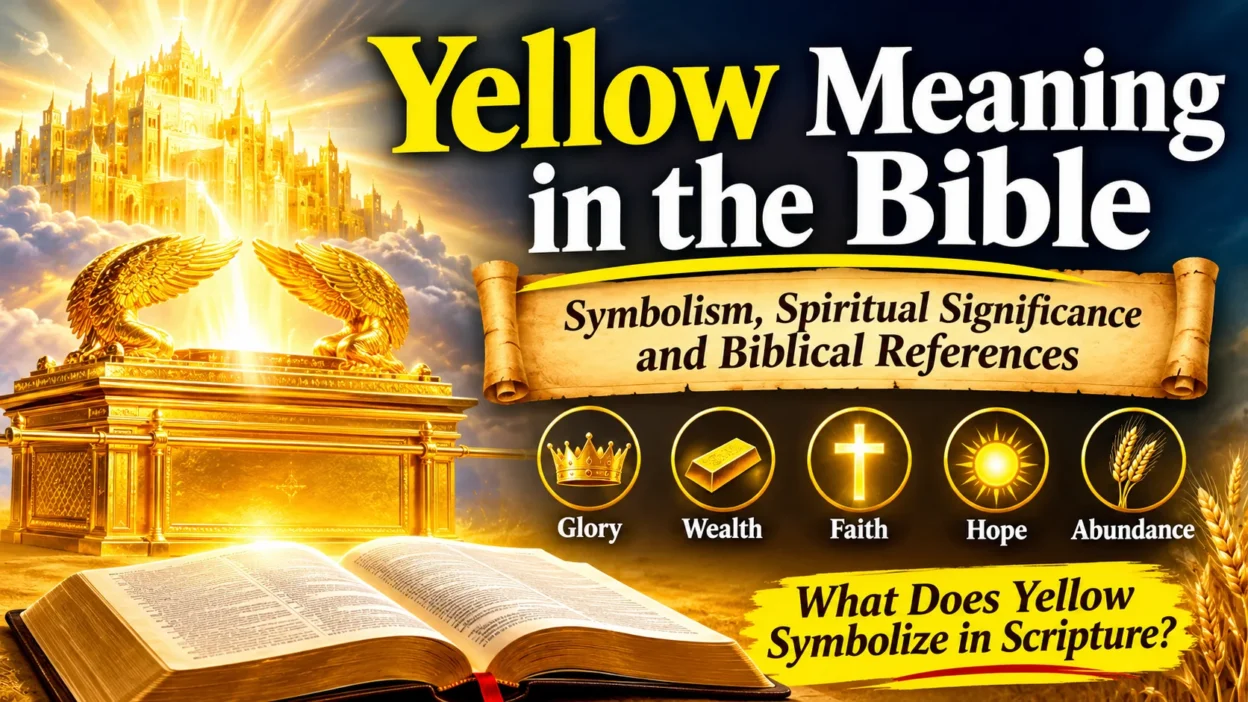
The yellow meaning in the Bible is commonly associated with gold, God’s glory, faith, wisdom, light, and spiritual value. Throughout Scripture, gold appears as a precious material used in the Tabernacle, Solomon’s Temple, and descriptions of the heavenly city.
Because yellow resembles gold and sunlight, many Christians connect this color with divine glory, hope, purity, and spiritual blessings. However, the Bible does not assign yellow one fixed spiritual meaning, so its interpretation depends on the biblical passage and context.
In addition to its connection with gold, yellow can remind believers of sunshine, ripe harvest fields, spiritual growth, and God’s provision. Some biblical passages also describe yellowish appearances in a completely different context, particularly in Leviticus 13.
Understanding these distinctions helps readers explore biblical color symbolism without assuming that every appearance of yellow represents a blessing. Let’s explore its spiritual significance, biblical references, Hebrew and Greek connections, and important lessons for Christian life.
Quick Answer: What Does Yellow Mean in the Bible?
The yellow meaning in the Bible is commonly connected with gold, glory, preciousness, faith, and divine beauty. Through its association with gold and light, yellow can also symbolize hope, wisdom, and spiritual growth. However, yellow has no single officially established biblical meaning, and its interpretation depends on the Scripture and context.
Why Do People Confuse the Biblical Meaning of Yellow?
People often confuse yellow with gold because both have similar appearances. However, they are not exactly the same in biblical symbolism.
Gold is a precious metal directly mentioned throughout the Bible, while yellow is a color whose spiritual associations are often developed through gold, sunlight, and other yellow-colored objects.
Another reason for confusion is that different Christian traditions interpret colors in different ways. Some connect yellow with happiness and hope, while others focus on its association with divine glory and preciousness.
Here are three important distinctions:
- Yellow: A bright color commonly associated with sunlight, warmth, and light.
- Gold: A valuable metal associated with wealth, honor, sacred objects, and heavenly imagery.
- Yellowish or pale appearances: Descriptions that may have a different meaning depending on the biblical passage.
Understanding these differences makes it easier to interpret the spiritual meaning of yellow accurately.
1. Gold and Divine Glory: What Does Yellow Represent?
One of the strongest symbolic connections of yellow in Christianity is gold and God’s glory.
Gold was considered extremely valuable in biblical times. It was used in sacred objects, religious decorations, and places of worship. Its beauty and preciousness made it an important material in descriptions of holiness and honor.
For example, Exodus 25:10–11 describes the Ark of the Covenant and explains that it was covered with pure gold.
The Ark was an important part of Israel’s worship and represented God’s covenant presence among His people.
This connection helps explain why Christians commonly associate yellow and gold with:
- God’s glory and majesty
- Divine beauty and holiness
- Spiritual value and honor
- Preciousness and sacredness
- God’s greatness and presence
Yellow can therefore serve as a visual reminder of God’s glory, although Scripture specifically describes the gold rather than assigning yellow a universal meaning.
2. Wealth and Prosperity: Does Yellow Symbolize Abundance?
Yellow is also commonly connected with wealth, prosperity, and material blessings because of its resemblance to gold.
In biblical times, gold was a sign of great wealth. Kings, wealthy individuals, and important religious buildings used it to demonstrate value and honor.
King Solomon’s reign provides a good example.
According to 1 Kings 10:14–23, Solomon received large quantities of gold, and his kingdom became famous for its wealth and prosperity.
This biblical account demonstrates the importance of gold in the ancient world.
From this connection, yellow may remind Christians of:
- God’s provision and blessings
- Wealth and abundance
- Gratitude for material resources
- Responsible stewardship
- The difference between earthly riches and spiritual treasures
However, the Bible also warns against making money and possessions more important than God. Matthew 6:19–21 teaches believers to focus on heavenly treasures rather than earthly wealth.
Therefore, the biblical symbolism of gold is not simply about becoming rich. It can also remind people to value spiritual blessings above material possessions.
3. Light and Glory: How Is Yellow Connected With God’s Light?
Yellow resembles sunlight, which makes it a natural symbol of brightness, warmth, and illumination.
Throughout Scripture, light is used to communicate important spiritual ideas. It can represent truth, guidance, righteousness, and God’s presence.
For example, Psalm 119:105 describes God’s word as a lamp for the feet and a light for the path.
This verse teaches that God’s guidance helps believers make wise decisions and follow the right direction.
Similarly, Revelation 21:11 describes the glory of the New Jerusalem as shining with extraordinary brilliance.
These passages help explain why yellow is sometimes associated with:
- Spiritual light
- God’s guidance and truth
- Divine glory
- Wisdom and understanding
- Hope during difficult times
Yellow can remind Christians that God’s wisdom provides direction when life feels uncertain.
It is important to remember that these connections come from biblical light imagery and Christian symbolism, not from a direct statement that yellow always represents God’s light.
4. Faith and Spiritual Purification: What Does Yellow Gold Teach?
Another meaningful connection comes from the biblical description of gold being tested and refined by fire.
Gold is valuable, but it must sometimes pass through intense heat to remove impurities.
The Bible uses this process as an illustration of genuine faith.
1 Peter 1:7 explains that tested faith is more precious than gold, even though gold itself is tested by fire.
This passage teaches that difficult experiences can reveal and strengthen a believer’s faith.
Job 23:10 also uses the image of being tested and coming forth like gold.
These references provide several spiritual lessons:
- Faith can become stronger through challenges.
- Difficult seasons can develop patience.
- Spiritual growth requires trust in God.
- A believer’s character can become stronger through testing.
- Genuine faith is more valuable than earthly possessions.
Through its connection with gold, yellow can serve as a reminder of faith, purification, endurance, and spiritual maturity.
5. Harvest and Abundance: Does Yellow Represent God’s Provision?
Yellow is also associated with ripe grain, wheat fields, and harvest seasons.
In the natural world, ripe wheat often develops a golden-yellow appearance. This makes yellow a useful visual reminder of food, provision, and abundance.
Harvest imagery appears throughout the Bible.
For example, Matthew 9:37–38 describes the harvest as plentiful but the workers as few. In this passage, Jesus uses the harvest as an illustration of the need for workers in God’s mission.
The harvest represents more than physical food. It also provides a picture of spiritual readiness and the gathering of people into God’s kingdom.
Yellow can therefore remind Christians of:
- God’s provision
- Gratitude for daily food
- Spiritual readiness
- Fruitfulness and growth
- The importance of helping others
The connection between yellow and harvest is a symbolic interpretation based on agricultural imagery rather than an official biblical color definition.
6. Wisdom, Hope, and Joy: What Is the Spiritual Meaning of Yellow?
Many Christians associate yellow with wisdom, hope, happiness, and positive thinking.
These associations are understandable because yellow resembles sunlight and brightness.
However, the Bible does not directly state that yellow represents all these qualities. Instead, believers may use the color as a personal reminder of biblical teachings.
Yellow and Wisdom
Light helps people see clearly, and biblical imagery often uses light to describe understanding and guidance.
James 1:5 encourages believers to ask God for wisdom when they lack it.
Yellow can therefore remind Christians to seek God’s wisdom before making important decisions.
Hope and Yellow
Yellow is often associated with sunshine and brighter days.
Romans 15:13 speaks about God filling believers with joy and peace as they trust in Him, so that they may overflow with hope.
This passage provides a strong biblical foundation for the Christian idea of hope, even though it does not specifically mention yellow.
Yellow and Happiness
Yellow is commonly associated with happiness and warmth because of its bright appearance.
Christian readers may connect this idea with biblical teachings about joy, gratitude, and thankfulness.
Psalm 118:24 encourages people to rejoice and be glad in the day the Lord has made.
In this way, yellow can serve as a reminder to appreciate God’s creation and remain thankful.
7. Yellow as a Sign of Weakness or Ritual Examination
Not every yellow-related biblical reference has a positive association.
Leviticus 13:30 describes an examination of certain skin conditions. It mentions yellowish or thin hair in the affected area as part of the priestly process for identifying a skin disease.
This passage belongs to the Old Testament laws concerning ritual cleanliness.
It should not be interpreted as proof that yellow always represents sickness, sin, or spiritual weakness.
Instead, it demonstrates an important principle: the meaning of a color depends on its biblical context.
A golden object in a sacred setting and a yellowish appearance in a skin examination serve entirely different purposes.
What Does Yellow Mean in Hebrew and Greek?
Studying biblical languages can provide additional insight into the way ancient Scripture describes colors and precious materials.
Hebrew Connection: Tsahob
Strong’s Hebrew 6669 lists the word tsahob, which means yellow or yellowish.
It is related to the Hebrew root associated with being yellow.
This is useful when studying Old Testament descriptions involving yellowish appearances, including the language of Leviticus 13.
It is important not to assume that every occurrence of this word carries a spiritual meaning. Its meaning depends on the passage.
Greek Connection: Chrysolithos
The Greek word chrysolithos refers to a precious yellowish or golden gemstone, commonly identified as chrysolite.
This type of precious stone appears in biblical descriptions of heavenly beauty.
Revelation 21:20 includes chrysolite among the precious stones associated with the foundations of the New Jerusalem.
Another related Greek gemstone name is chrysoprasos, referring to chrysoprase, generally described as a greenish or golden-green gemstone.
These references show that biblical color descriptions sometimes involve precious stones rather than simple modern color categories.
Important Bible Verses Related to Yellow and Gold
Although the Bible does not provide a complete list of spiritual meanings for yellow, several passages help explain its connection with gold, light, faith, and abundance.
| Bible Verse | Biblical Description | Spiritual Lesson |
| Exodus 25:10–11 | The Ark of the Covenant covered with pure gold | Sacredness and honor |
| 1 Kings 10:14–23 | Solomon’s wealth and abundance of gold | Prosperity and responsibility |
| Job 23:10 | Tested and refined like gold | Faith through difficulties |
| Psalm 119:105 | God’s word described as a light | Guidance and wisdom |
| Matthew 9:37–38 | The harvest is plentiful | Spiritual readiness |
| 1 Peter 1:7 | Faith compared with tested gold | Genuine faith |
| Revelation 21:11 | The glory of the New Jerusalem | Heavenly beauty |
| Revelation 21:18 | The city described as pure gold | Preciousness and divine glory |
These verses provide the biblical foundation for many Christian interpretations associated with yellow and gold.
Yellow vs. Gold: What Is the Biblical Difference?
Yellow and gold may look similar, but their meanings are not identical.
| Feature | Yellow | Gold |
| Type | A color | A precious metal |
| Biblical usage | Appears in certain color descriptions and translations | Frequently mentioned |
| Symbolic association | Light, warmth, and hope | Value, honor, and glory |
| Spiritual interpretation | Often based on color symbolism | Supported by many biblical passages |
| Example | Yellowish appearance in Leviticus 13 | Gold in Exodus 25:11 |
The main difference is that gold has a direct and extensive biblical presence, while many spiritual interpretations of yellow come from its visual connection with gold, sunlight, and harvest imagery.
What Are the Common Christian Interpretations of Yellow?
Christians may associate yellow with several spiritual lessons.
- God’s glory: Gold reminds believers of God’s greatness and majesty.
- Faith: Refined gold illustrates faith that remains strong through difficulties.
- Purity: The refining process provides an image of removing impurities.
- Wisdom: Light can remind believers to seek God’s understanding.
- Hope: Sunshine-like yellow can represent encouragement and brighter days.
- Joy: Its brightness can remind people to appreciate God’s blessings.
- Abundance: Golden harvest fields can represent provision and fruitfulness.
- Honor: Gold was used in sacred and royal settings.
- Spiritual growth: Testing can develop patience and maturity.
- Heavenly beauty: Gold and precious stones appear in descriptions of the New Jerusalem.
These are common symbolic applications, not ten meanings directly assigned to yellow by the Bible.
Common Mistakes About the Yellow Meaning in the Bible
When studying biblical color meanings, it is important to avoid several common misunderstandings.
- Assuming yellow always represents God: Yellow can have different meanings depending on the passage.
- Confusing yellow with gold: Yellow is a color, while gold is a precious metal.
- Believing yellow always means happiness: This is a common cultural association, not a direct biblical teaching.
- Thinking yellow always represents wealth: Biblical teachings also warn against loving money.
- Ignoring negative or neutral contexts: Leviticus 13 uses yellowish descriptions in a ritual examination.
- Treating dreams as guaranteed messages: The Bible does not establish one universal meaning for seeing yellow in a dream.
- Ignoring the original context: A verse should be understood according to its historical, literary, and biblical setting.
The best approach is to study the entire passage rather than assigning a spiritual meaning to a single color.
How Can You Remember the Spiritual Meaning of Yellow?
A simple memory trick can help you understand the common Christian associations of yellow.
Remember these four words:
- Gold: Value and glory.
- Light: Wisdom and guidance.
- Harvest: Abundance and provision.
- Sunshine: Hope and joy.
Together, these ideas explain why yellow is commonly associated with positive spiritual symbolism.
Remember that these are helpful associations, not an official biblical color code.
Does Yellow Have the Same Meaning in American and British English?
Yes. The word yellow has the same basic meaning in both American and British English.
Both varieties use yellow to describe a color between green and orange.
The main difference is in the spelling of certain related words.
| American English | British English |
| Yellow | Yellow |
| Gold | Gold |
| Color | Colour |
| Symbolism | Symbolism |
The biblical interpretation of yellow and gold remains the same in both varieties of English.
Similar Colors and Their Biblical Meanings
Yellow is not the only color that carries symbolic associations in Christian discussions.
Other colors also appear in important biblical passages.
- Blue: Often associated with heavenly imagery, divine commandments, and God’s presence.
- Red: Commonly connected with blood, sacrifice, and redemption.
- White: Frequently associated with purity, holiness, and righteousness.
- Purple: Often represents royalty, honor, and authority.
- Green: Commonly associated with life, growth, and renewal.
- Gold: Represents preciousness, honor, wealth, and sacred beauty.
These biblical color meanings come from different passages and Christian interpretations. Like yellow, each color should be understood in its proper context.
Final Verdict: What Does Yellow Mean in the Bible?
The yellow meaning in the Bible is most commonly understood through its connection with gold, light, divine glory, faith, wisdom, and abundance.
Gold provides the strongest biblical foundation for these interpretations because it appears throughout Scripture in descriptions of sacred objects, royal wealth, tested faith, and the New Jerusalem.
Yellow can also serve as a personal Christian reminder of hope, joy, spiritual growth, and God’s provision. However, these additional meanings should not be presented as direct biblical definitions.
Ultimately, Scripture should guide the interpretation of every color. Understanding the difference between biblical references and symbolic applications helps readers discover meaningful spiritual lessons without misunderstanding God’s Word.
Frequently Asked Questions
1. What does yellow mean in the Bible spiritually?
Yellow is commonly associated with gold, God’s glory, faith, wisdom, hope, and spiritual value. These associations mainly come from Christian interpretations of gold and light imagery rather than one direct biblical definition of yellow.
2. Is yellow mentioned in the Bible?
Yellow or yellowish descriptions appear in some biblical translations and passages. Leviticus 13:30, for example, describes yellowish hair during the examination of certain skin conditions. Gold and precious yellowish gemstones also appear in Scripture.
3. Does yellow represent God’s glory in the Bible?
Yellow is commonly associated with God’s glory because of its resemblance to gold. Exodus 25:11 describes the Ark of the Covenant as covered with pure gold, demonstrating the importance of gold in sacred worship.
4. What does yellow gold symbolize in the Bible?
Gold is associated with preciousness, wealth, honor, and sacred beauty. It was used in the Tabernacle, the Temple of Solomon, and descriptions of the New Jerusalem.
5. Does yellow represent faith in Christianity?
Yellow itself is not directly defined as a symbol of faith. However, 1 Peter 1:7 compares genuine faith with gold tested by fire, making gold a powerful biblical illustration of faith that remains strong through difficulties.
6. Is yellow a positive or negative color in the Bible?
Yellow does not have one universal positive or negative meaning. Its interpretation depends on its context. Gold-related imagery generally has positive associations, while yellowish descriptions in Leviticus 13 relate to ritual examination.
7. What does seeing yellow in a dream mean biblically?
The Bible does not provide a universal interpretation of seeing yellow in dreams. Some Christians personally associate yellow with hope, light, wisdom, or God’s glory, but a yellow object in a dream should not automatically be treated as a divine message.
8. What Bible verse is connected with yellow and gold?
Exodus 25:11 is an important verse because it describes the Ark of the Covenant being covered with pure gold. First Peter 1:7 is another important reference because it compares tested faith with gold tested by fire.
Remember This
The yellow meaning in the Bible is commonly associated with gold, God’s glory, faith, wisdom, light, hope, and abundance. Gold has a clear biblical foundation, while many additional meanings of yellow come from Christian symbolism and interpretation.
Always remember that the context of Scripture matters more than assigning one fixed meaning to a color.
Conclusion
The color yellow carries several meaningful associations in Christian symbolism. Through its connection with gold, it can remind believers of God’s glory, preciousness, honor, and the value of genuine faith. Biblical passages such as Exodus 25:11, Job 23:10, and 1 Peter 1:7 help explain why gold is an important image of sacred value and spiritual testing. Yellow can also remind Christians of sunlight, wisdom, hope, joy, and the abundance represented by harvest imagery.
Ultimately, the yellow meaning in the Bible should be understood through careful study of Scripture. While the Bible does not assign yellow one universal spiritual definition, its connections with gold, light, and harvest provide useful ways to reflect on God’s greatness, guidance, and provision. By understanding the biblical context, readers can appreciate the spiritual lessons behind these beautiful images.