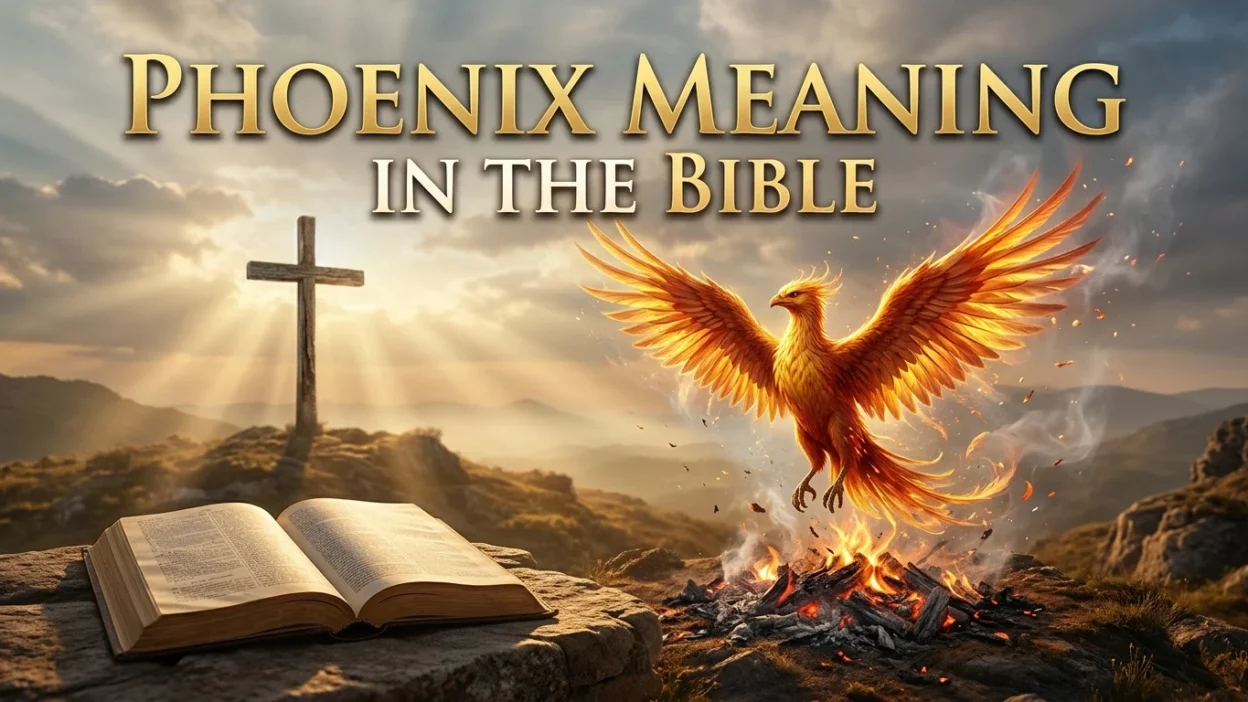
The phoenix meaning in the Bible is closely associated with resurrection, spiritual renewal, hope, and the promise of new life after suffering. The phoenix is a legendary bird that, according to ancient stories, dies in fire and rises again from its ashes.
Although it is not presented as an ordinary biblical bird, early Christian writers used the phoenix as a powerful symbol to explain the resurrection of the dead and the new life promised through Jesus Christ. One of the earliest examples appears in 1 Clement 25, an early Christian writing that describes the phoenix as an illustration of resurrection.
The connection between the phoenix and Scripture also involves Job 29:18 and Psalm 92:12. Some ancient translations and Christian writers associated these passages with the phoenix, although their meanings are debated.
Beyond its historical symbolism, the phoenix offers a meaningful picture of spiritual transformation: leaving behind an old way of life, growing through suffering, and finding renewed strength through faith. Understanding its history helps explain why this legendary bird became an important image in early Christian reflection.
Quick Answer: What Is the Phoenix Meaning in the Bible?
The phoenix meaning in the Bible is commonly associated with resurrection, renewal, hope, and life after suffering. Although the legendary bird is not clearly identified in the Hebrew Bible, early Christian writers such as Clement of Rome and Tertullian used its traditional story as an illustration of resurrection. Its symbolism can remind Christians of new life through Jesus Christ.
Why Do People Connect the Phoenix With the Bible?
People connect the phoenix with the Bible because its traditional story resembles the Christian message of resurrection and new life.
According to ancient mythology, the phoenix is a unique bird that lives for many years before dying in fire and rising again from its ashes. Its story represents the idea that an ending does not always mean the loss of hope.
Early Christians found this image useful when discussing God’s power to raise the dead. In 1 Clement 24–25, the writer uses examples from nature, including the phoenix, to illustrate the hope of resurrection. Tertullian also discusses the bird in Chapter 13 of On the Resurrection of the Flesh.
The phoenix became connected with several Christian themes:
- Resurrection: God’s power to bring the dead back to life.
- Spiritual renewal: Becoming stronger through faith and God’s grace.
- Hope: Trusting God during suffering and uncertainty.
- Transformation: Leaving sinful habits and developing a new way of life.
- Restoration: Finding new strength after loss, hardship, or disappointment.
- Eternal life: The Christian hope of life beyond physical death.
However, the phoenix itself is a mythical creature. Its story is a symbolic illustration, not proof of the Christian resurrection.
What Does the Word Phoenix Mean?
The word phoenix refers to a legendary bird traditionally associated with rebirth, renewal, and immortality.
The name comes through ancient Greek, and stories about similar extraordinary birds appeared in several ancient cultural traditions. The phoenix is often described as a beautiful bird with brilliant red, gold, and orange feathers.
Its traditional story follows a remarkable cycle:
- The phoenix lives for a very long time.
- It reaches the end of its life.
- It dies or is consumed by fire, depending on the version of the legend.
- A new phoenix emerges from the ashes.
- The bird begins another life cycle.
This story made the phoenix a lasting symbol of hope and renewal.
In Christian symbolism, the phoenix became an illustration of resurrection because its legendary return to life provided an understandable picture of life overcoming death.
It is important to distinguish between the legendary story and Christian belief. Christians do not need to believe in a literal phoenix to understand the biblical promise of resurrection.
What Does the Word Bible Mean?
The Bible is the sacred collection of writings that Christians believe communicates God’s message, promises, guidance, and teachings.
It contains two main sections:
- Old Testament: Includes creation, the history of Israel, the Law, wisdom literature, poetry, and prophecy.
- New Testament: Focuses on Jesus Christ, His teachings, His death and resurrection, and the beginnings of the Christian church.
The Bible teaches that God gives people new life through faith, forgiveness, spiritual transformation, and the promise of resurrection.
For this reason, the phoenix is sometimes used as a symbolic way to discuss biblical ideas. However, the Bible’s teachings should be understood through Scripture and its historical context rather than through mythology alone.
Is the Phoenix Mentioned in the Bible?
The answer depends on what is meant by the word phoenix.
The legendary bird is not clearly identified in the Hebrew text of the Old Testament as the creature described in ancient mythology. However, some historical translations and early Christian interpretations connect the phoenix with particular biblical passages.
Two passages are especially important.
1. Job 29:18 and the Phoenix
Job 29:18 is one of the most discussed Bible verses in conversations about the phoenix.
In the King James Version, Job says:
“I shall die in my nest, and I shall multiply my days as the sand.”
The wording varies between Bible translations. Some translations describe Job expecting to die peacefully in his home, surrounded by the security of his family. Other historical interpretations connect the verse’s language about a long life with the phoenix.
The ancient Greek translation of the Old Testament, known as the Septuagint, uses wording that can be associated with either a palm tree or a phoenix. This translation history helps explain why the phoenix became connected with the passage.
However, the Hebrew text does not establish that Job was directly describing a legendary phoenix. The verse is better understood in its context as Job expressing his former confidence that he would enjoy a long and peaceful life.
2. Psalm 92:12 and the Phoenix
Psalm 92:12 is another important passage in the history of Christian phoenix symbolism.
The King James Version reads:
“The righteous shall flourish like the palm tree: he shall grow like a cedar in Lebanon.”
The Hebrew word traditionally translated as palm tree is connected with the Greek word phoinix, which can refer to a palm tree or a phoenix.
This linguistic connection influenced early Christian interpretation.
Tertullian, an early Christian writer, referred to the phoenix when discussing the resurrection of the human body in On the Resurrection of the Flesh, Chapter 13. He understood the image as a reminder that God could restore life even after death.
This is a historical example of how early Christians interpreted the phoenix symbolically. It does not mean that every modern Bible translation identifies the bird in Psalm 92:12.
How Did Early Christians Use the Phoenix as a Symbol of Resurrection?
The phoenix has a particularly interesting place in early Christian literature.
Some early Christian writers used the bird’s legendary life cycle to explain the hope of resurrection to readers who were familiar with ancient stories about it.
The Phoenix in 1 Clement 24–25
One of the earliest Christian references appears in 1 Clement, traditionally attributed to Clement of Rome.
In Chapter 24, the writer discusses examples from nature that illustrate the possibility of resurrection. He describes the cycle of night and day and the growth of seeds after they are buried in the ground.
Chapter 25 then introduces the phoenix as another illustration of resurrection.
The writer describes the legendary bird’s return to life and uses the story to encourage confidence in God’s power to raise the dead.
The central message is that God is powerful enough to bring life where people see death and an ending.
The Phoenix in Tertullian’s Writing
Tertullian also discusses the phoenix in his work On the Resurrection of the Flesh, Chapter 13.
He uses the legendary bird as an illustration of bodily resurrection and connects it with the wording of Psalm 92:12 in the Greek tradition.
For Tertullian, the phoenix provided an image that helped explain the Christian hope that the human body could be raised through God’s power.
These writings show that the phoenix was more than a general symbol of personal improvement in some early Christian discussions. It was also used to illustrate the resurrection of the body.
Phoenix vs. Biblical Resurrection: What Is the Difference?
Although phoenix symbolism and Christian resurrection share similar imagery, their meanings are not identical.
| Phoenix Symbolism | Biblical Resurrection |
| Comes from ancient mythology | Comes from Christian biblical teaching |
| Describes a legendary bird | Focuses on God’s power over death |
| Rises from its ashes in traditional stories | Jesus rises from the dead |
| Represents renewal and rebirth | Represents victory over death and eternal life |
| Follows a mythical life cycle | Is connected with God’s saving work |
| Can symbolize a fresh beginning | Offers hope through Jesus Christ |
The main difference is that the phoenix is a legendary symbol, while the resurrection of Jesus Christ is a central Christian belief.
The phoenix can help illustrate resurrection, but it does not replace the biblical message.
What Is the Spiritual Meaning of the Phoenix?
The spiritual meaning of the phoenix is often connected with overcoming difficulties, developing faith, and receiving new strength after suffering.
Its symbolism can help explain several aspects of the Christian journey.
1. Resurrection and New Life
The phoenix is often associated with resurrection because of its legendary return from the ashes.
For Christians, this image can remind them of the resurrection of Jesus Christ.
In 1 Corinthians 15:20, Paul describes Christ as the firstfruits of those who have died. This passage emphasizes that the resurrection of Jesus is the foundation of Christian hope.
2. Spiritual Renewal
The phoenix can represent the process of leaving an old life behind and becoming spiritually renewed.
Romans 12:2 teaches believers not to conform to the pattern of this world but to be transformed by the renewing of their minds.
This transformation involves developing new thoughts, attitudes, and actions through faith.
3. Hope During Difficult Times
The phoenix is a symbol of hope because its story does not end with destruction.
Similarly, Christians are encouraged to trust God during periods of suffering, uncertainty, and disappointment.
Romans 8:18 reminds believers that present sufferings cannot be compared with the glory that will be revealed.
4. Strength After Weakness
The phoenix can also symbolize renewed strength.
Isaiah 40:31 teaches that those who hope in the Lord will renew their strength.
This verse encourages believers to depend on God rather than relying only on their own abilities.
5. Restoration After Loss
The phoenix’s return from the ashes can represent the possibility of rebuilding after loss.
The story of Job provides an important biblical example. Job experienced terrible suffering, but his story also describes God’s restoration and his continued faith.
Job’s experience reminds readers that suffering is not necessarily the end of their story.
What Does the Phoenix Teach About Spiritual Struggle?
The phoenix can also serve as an illustration of the difficulties involved in spiritual growth.
Following Christ does not mean that life will always be easy. The Christian journey involves resisting temptation, developing patience, praying regularly, and choosing faith during difficult situations.
The Struggle Between Good and Evil
In Romans 7:19, Paul describes the struggle of wanting to do what is right while recognizing the presence of sin.
This passage shows that spiritual growth involves an ongoing struggle with human weakness.
The phoenix can symbolically represent the hope of becoming stronger through this process of transformation.
The Fire of Spiritual Transformation
In Christian reflection, fire is sometimes used as an image of purification, testing, and transformation.
The phoenix’s legendary fire can therefore provide a picture of leaving behind destructive habits and becoming spiritually renewed.
However, this is a symbolic comparison. The Bible does not teach that suffering automatically makes someone spiritually pure.
Carrying the Cross and Following Jesus
Luke 9:23 records Jesus teaching His followers to deny themselves, take up their cross daily, and follow Him.
This teaching highlights sacrifice, commitment, and faithfulness.
The Christian journey is not simply about becoming successful after hardship. It is about allowing God to transform one’s heart and life.
12 Examples of Phoenix Symbolism and Biblical Connections
Here are twelve practical examples showing how the phoenix can be connected with Christian ideas.
- New beginnings: The phoenix represents beginning again after a difficult season.
- Resurrection: Its legendary return to life can illustrate the Christian hope of resurrection.
- Spiritual renewal: It can symbolize becoming closer to God through faith and prayer.
- Hope after suffering: Its story reminds readers that hardship does not have to destroy hope.
- Transformation: The phoenix can represent leaving sinful habits behind and developing a new way of living.
- Strength through faith: Its symbolism connects with the promise of renewed strength in Isaiah 40:31.
- Restoration: Job’s story illustrates how faith can continue even during painful experiences.
- Victory over death: The phoenix can serve as an illustration of the resurrection message in 1 Corinthians 15.
- Patience: Its life cycle can remind people to remain patient during periods of change.
- Spiritual growth: It can represent becoming more mature through prayer, Scripture, and faith.
- Overcoming temptation: Its symbolism can illustrate the struggle to leave destructive choices behind.
- Eternal hope: It can remind Christians of the hope of everlasting life through Jesus Christ.
These examples are symbolic applications rather than twelve separate biblical teachings about the phoenix.
What Is an Easy Memory Trick for Phoenix Meaning?
A simple way to remember the phoenix meaning is:
Phoenix = Resurrection, Renewal, and Hope.
Think of three important ideas:
- Resurrection: Life overcoming death.
- Renewal: Becoming spiritually stronger.
- Hope: Trusting God during difficult times.
For a Christian understanding, remember this distinction:
- The phoenix is a legendary illustration of rebirth.
- Jesus Christ is the center of the Christian resurrection message.
- Spiritual renewal comes through God’s transforming work.
This simple memory trick helps you understand the connection without confusing mythology with biblical teaching.
Is Phoenix Used Differently in American and British English?
The word phoenix has the same spelling and basic meaning in American and British English.
Both varieties use it to describe the legendary bird associated with rebirth and renewal.
| Feature | American English | British English |
| Spelling | Phoenix | Phoenix |
| Meaning | Legendary bird | Legendary bird |
| Pronunciation | FEE-niks | FEE-niks |
| Symbolism | Rebirth and renewal | Rebirth and renewal |
| Religious usage | Resurrection symbolism | Resurrection symbolism |
There is no major spelling difference between the two varieties.
The word can also describe a person, organization, or community that recovers and becomes successful after a difficult experience.
What Are Similar Words and Symbols Related to Phoenix?
Several words and symbols are connected with the phoenix because they express ideas of renewal, hope, and transformation.
- Resurrection: Returning from death to life, especially through God’s power in Christian teaching.
- Rebirth: Beginning a new life or experience.
- Renewal: Receiving fresh strength, energy, or purpose.
- Restoration: Bringing something back to a better condition.
- Transformation: Changing in character, attitude, or behavior.
- Redemption: Being saved or delivered from sin.
- New creation: Becoming new through God’s transforming power.
- Hope: Trusting that a better future is possible.
- Regeneration: Spiritual renewal and new life through God’s work.
These words are related but do not have exactly the same meanings. For example, resurrection has a specific theological meaning in Christianity, while rebirth can describe a general personal change.
Final Verdict: What Does the Phoenix Really Mean in the Bible?
The phoenix is an ancient legendary bird that became an important symbol in early Christian discussions of resurrection. Although the Bible does not clearly identify the mythical bird in its original Hebrew text, its imagery became connected with Job 29:18 and Psalm 92:12 through ancient translation traditions and Christian interpretation.
The writings of Clement of Rome and Tertullian show that early Christians used the phoenix to illustrate God’s power to bring life from death. Its symbolism also connects naturally with hope, spiritual renewal, restoration, and transformation. For Christians, however, the foundation of resurrection is not the phoenix but Jesus Christ, whose resurrection is central to the Christian faith.
Frequently Asked Questions
1. Is the phoenix mentioned in the Bible?
The legendary phoenix is not clearly identified as a mythical bird in the Hebrew Bible. However, some historical translations and early Christian interpretations connect it with Job 29:18 and Psalm 92:12. Early Christian writers also used the phoenix as an illustration of resurrection.
2. What Bible verse talks about the phoenix?
Job 29:18 and Psalm 92:12 are the two passages most commonly discussed in connection with the phoenix. Their wording varies across translations, and the connection depends partly on ancient Greek translation traditions.
3. What does the phoenix symbolize in Christianity?
In historical Christian symbolism, the phoenix represents resurrection, new life, and God’s power over death. Early Christian writers used its legendary rebirth as an illustration of the resurrection of the body.
4. What does the phoenix rising from ashes mean spiritually?
The phoenix rising from ashes symbolizes hope, transformation, and renewal after hardship. In a Christian context, it can illustrate spiritual growth and the promise of new life through faith in God.
5. Why did early Christians use the phoenix as a resurrection symbol?
Early Christians used the phoenix because its legendary return from death provided a familiar illustration of resurrection. In 1 Clement 25 and Tertullian’s On the Resurrection of the Flesh, the bird is used to discuss the hope of life after death.
6. Does the phoenix represent Jesus Christ?
The phoenix can symbolically remind Christians of Jesus Christ’s resurrection, but it is not Jesus or a biblical representation of Him in the direct sense. The Christian message of resurrection is based on Jesus’ death and resurrection, not on the mythology of the phoenix.
7. What is the difference between the phoenix and the Holy Spirit?
The phoenix is a legendary bird associated with rebirth. The Holy Spirit is God’s Spirit in Christian belief, associated with spiritual renewal, guidance, and transformation. They are different concepts, although both may appear in discussions about new life.
8. Is the phoenix a good Christian symbol?
The phoenix has a historical place in Christian symbolism, particularly as an illustration of resurrection. Christians may use it as a reminder of hope and new life while recognizing that it comes from ancient mythology rather than being a required biblical symbol.
Remember This
- The phoenix is a legendary bird associated with rebirth and renewal.
- Early Christians used the phoenix as an illustration of resurrection.
- 1 Clement 24–25 contains an early Christian discussion of the phoenix.
- Tertullian discussed the phoenix in On the Resurrection of the Flesh, Chapter 13.
- Job 29:18 and Psalm 92:12 have historical connections with phoenix interpretations.
- The phoenix can symbolize hope, spiritual growth, and restoration.
- Jesus Christ’s resurrection, not the mythical phoenix, is the foundation of Christian belief.
Conclusion
The phoenix meaning in the Bible has a deeper historical and spiritual connection than simply representing a mythical bird rising from ashes. Although the phoenix is not clearly identified as a legendary creature in the Hebrew Scriptures, early Christian writers used its traditional story to explain resurrection and the hope of new life.
The writings of Clement of Rome and Tertullian demonstrate how this image became part of early Christian reflection. Job 29:18 and Psalm 92:12 also help explain the historical relationship between the phoenix, ancient translations, and biblical interpretation.
For Christians today, the phoenix can serve as a meaningful illustration of hope, restoration, and spiritual renewal during difficult times. Its story reminds readers that suffering does not have to be the end of hope.
More importantly, the Christian message points to Jesus Christ, whose resurrection represents God’s victory over death and the promise of eternal life. Through faith, prayer, patience, and spiritual transformation, believers can continue their journey with confidence in God’s promises.