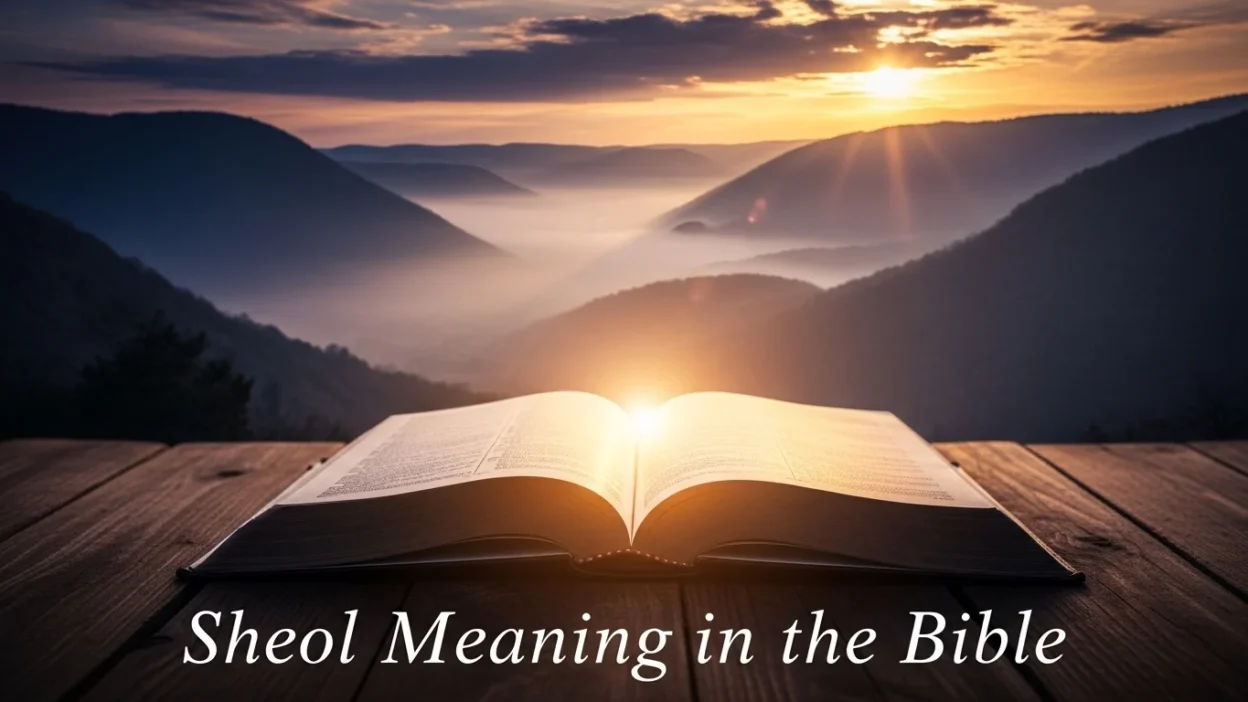
Imagine standing in a quiet place at sunset. The sky grows dark, and everything feels still. You may think about life, death, and what comes after. Many people have asked this question for thousands of years.
The Bible also talks about this mystery.
In the Old Testament, there is a word that appears many times when speaking about death and the place where the dead go. That word is Sheol.
You might see it while reading a verse. Or maybe you heard it in a sermon or Bible study. It can make you wonder: What does Sheol really mean in the Bible?
Is it the same as hell? Is it simply the grave? Or does it hold a deeper spiritual message about life, death, and God’s plan?
Understanding the Sheol meaning in the Bible can help us see how people in ancient times viewed death. More importantly, it helps us understand God’s promise of hope and life beyond the grave.
The Bible does not talk about Sheol only with fear. It also speaks about God’s power to rescue, guide, and bring life even from the deepest place.
Let’s explore what Sheol means in Scripture and what spiritual lessons it can teach us today.
Biblical Meaning of Sheol in the Bible
The Sheol meaning in the Bible is often described as the place of the dead. In the Old Testament, Sheol refers to the realm where people go after death.
It is not always described as a place of punishment. Instead, it is often seen as a silent and shadowy place where the dead rest.
One clear example appears in Psalm 16:10:
“For you will not abandon my soul to Sheol, nor will you let your Holy One see decay.”
This verse shows something powerful. Even though Sheol represents death, God has the power to save people from it.
Another verse appears in Ecclesiastes 9:10:
“Whatever your hand finds to do, do it with all your might, for in Sheol, where you are going, there is neither working nor planning nor knowledge nor wisdom.”
Here, Sheol is described as a place where normal human activity stops. Life’s work and struggles are finished there.
In Genesis 37:35, Jacob speaks about Sheol when he mourns his son Joseph:
“I will go down to Sheol to my son in mourning.”
In this context, Sheol simply means the grave or the place where the dead rest.
This shows that Sheol was understood as the common destination for all people, both righteous and unrighteous.
But the Bible also hints that Sheol is not the final answer.
For example, Psalm 49:15 says:
“But God will redeem my life from the grave; he will surely take me to himself.”
This verse gives hope. Even though Sheol represents death, God’s power is greater than the grave.
Later in the Bible, the message becomes clearer. The New Testament reveals that Jesus Christ conquered death.
In Acts 2:31, Peter explains that Jesus was not left in the realm of the dead.
Through Christ, believers are given the promise of eternal life and victory over death.
So the deeper Christian meaning of Sheol is this: death is real, but it is not stronger than God’s promise.
Spiritual Significance and Symbolism
Beyond its literal meaning, Sheol also carries spiritual symbolism.
In the Bible, it can represent moments when a person feels lost, broken, or far from hope.
Sometimes life brings deep valleys. A person may feel surrounded by darkness, fear, or grief. Spiritually, these moments can feel like being in Sheol.
Yet the Bible reminds us that God’s presence can reach even there.
In Psalm 139:8, David says:
“If I ascend to heaven, you are there; if I make my bed in Sheol, you are there.”
This is a powerful spiritual message. It means there is no place where God cannot reach us.
Even in our darkest moments, God is still near.
Sheol also reminds believers to live with faith and purpose. Life on earth is precious. Each day is a gift to grow closer to God, love others, and walk in faith.
For many Christians, this understanding leads to a spiritual awakening. It encourages people to trust God more deeply and to remember that life is not only about this world.
Through faith, believers look forward to the hope of resurrection and eternal life.
Biblical Interpretations in Dreams or Real Life
Sometimes people wonder if symbols like Sheol appear in dream interpretation or spiritual reflection.
In dreams, a dark place, a grave, or a deep pit can sometimes represent the symbolism of Sheol.
This does not always mean something negative. Often it reflects a season of change or spiritual struggle.
For example:
- A dream of being in darkness may show a time of confusion or hardship.
- Climbing out of a pit or grave may symbolize God bringing hope and restoration.
- Seeing light after darkness can represent spiritual renewal and divine guidance.
The Bible often shows that God rescues people from the pit.
In Psalm 40:2, David writes:
“He lifted me out of the slimy pit, out of the mud and mire; he set my feet on a rock.”
This reminds believers that even when life feels like a deep valley, God is still working.
Prayer, faith, and trust in the Lord can bring peace and direction during these times.
Practical Lessons & Faith Insights
The Sheol meaning in the Bible teaches several simple but powerful lessons:
- Life is precious, so live each day with purpose.
- God’s presence reaches everywhere, even in darkness.
- Faith gives hope beyond death.
When life feels heavy, bring your worries to God in prayer. Trust His guidance and remember that His love is stronger than any shadow.
Conclusion
The Sheol meaning in the Bible points to the ancient understanding of death as the place of the dead. Yet the Bible does not stop there.
Scripture shows that God has power even over Sheol. Through His promise and through Jesus Christ, believers are given hope beyond the grave.
So while Sheol reminds us of life’s limits, it also points us toward something greater God’s promise of eternal life, restoration, and peace.
When you think about these truths, let them draw your heart closer to God. In every season of life, trust that His light can reach even the deepest places.